“Let no corrupt word proceed out of your mouth, but what is good for necessary edification, that it may impart grace to the hearers.”
Ephesians 4:29
“But no man can tame the tongue. It is an unruly evil, full of deadly poison. With it we bless our God and Father, and with it we curse men, who have been made in the similitude of God. Out of the same mouth proceed blessing and cursing. My brethren, these things ought not to be so.”
James 3:8-10
Last week our thoughts were focused on the question, “Where have we been?”, and we discussed the fact that history is settled and unchangeable. What has happened has happened, and nothing can be done to revise it. It doesn’t matter how much effort is put into changing the past, it simply cannot be done. History is a settled reality.
I mentioned then that this week’s blog would focus on the development of language. Unlike history, language is not settled and unchangeable. It can be revised, changed, tweaked, and redefined. Some words change meaning, while others become obsolete. New words are constantly added to the vocabulary. Vocabulary is fluid, changing with the flow of culture at different points of history. There are words that are commonly used in our present generation that were not used in previous generations.
However, with the passing of each generation, and the changing of commonly used words as some are discarded while others are added, the professing believer in Jesus Christ – the one who claims to be Jesus’ disciple – should be guided by Biblical principles in the proper use of language. The verses quoted at the beginning of this blog provide a good starting point for a discussion of this subject.
First, Paul says that we should not allow any corrupt word to proceed out of our mouths. Rather we are to use our words for the purpose of edifying and imparting grace. To edify is to build up, to encourage, to instruct intellectually or morally. It is derived from the word ‘edifice’, which refers to a building. So, the word means that we should build up other persons. To this is added the admonition to impart grace, which means to give, to extend, convey, or grant grace. Grace can be thought of as unmerited kindness or favor. It is showing someone kindness who does not deserve such a loving action. Thus, we are to use the vehicle of language to build up, to edify, and to extend kindness to the undeserving.
Then, James tells us about the difficulty of taming the tongue. To illustrate his point, he speaks of the damage the tongue can inflict when used in sinful, selfish ways. It is, he says, an unruly evil, full of deadly poison. Persons have been crushed by an unkind, cutting word spoken against them. Someone’s tongue has spewed evil at them, and they are left reeling in the aftermath of the verbal onslaught. Instead of building up and extending grace, the words are meant to tear down and destroy.
The direction of a child’s life can be dramatically and drastically altered by constant criticism from parents, siblings, peers, or teachers. If a child constantly hears negative, critical, verbal assaults from an authority figure, they will grow to believe what they have been subject to. A child can grow to think that he/she is worthless if they are battered by a parent telling him/her that they will never amount to anything.
And, if a child is reared in an environment where they constantly hear his/her parents use profane, vulgar language, then they will embrace that vocabulary as their own. Language is a powerful force, carrying with it the power to build up or the tear down.
James goes on to speak about words which bless God and curse man, which he says should never happen. But, we’ve all seen it haven’t we? On social media we see a comment by someone praising God, and their next post has some defaming, unkind, destructive remark about some person. Friends, this kind of evil, inflammatory speech should never proceed from the mouth of one who claims to be a disciple of Jesus Christ.
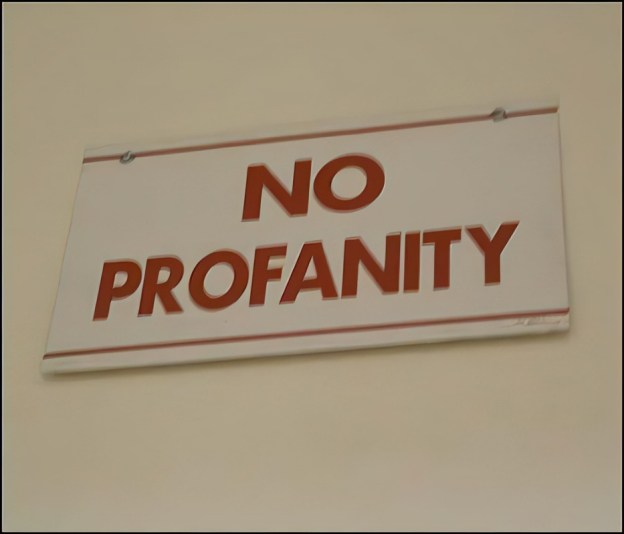
There is so much more that needs to be said, but for the sake of brevity I will mention just one more area of language: profanity. The use of vulgar, profane speech has become so common in our present cultural climate. But is such use of language proper for a Christian? The answer is a resounding NO! Our speech is to build up, edify, impart grace, show kindness, which cannot be accomplished using profane and vulgar vocabulary.
I met a man recently who used such unbelievably vulgar language that I was shocked to discover he had previously served as a minister to youth in a local church. When I began asking him how he could justify his choice of words he actually made an attempt to justify using such vile language. It is not an exaggeration to say that probably 25% of his vocabulary was vulgar and profane.
But in his estimation, he was simply using the commonly used language of our culture. However, the Bible teaches that Christians should be counter-cultural, not to accommodate culture. We are to be lights shining in the darkness, not conforming to the darkness.
Profanity and vulgarity are commonplace in our modern society. We are inundated with it in movies and television programs. It is the language of the people. But it should not be the language of the believer in Jesus Christ. Our language should be edifying to people, and glorifying to God. We are to be a holy priesthood, ministering grace to those who hear us.
If we grovel in the pigpen of profanity, we will come out with filthiness as our flagship vocabulary. But if we fill our minds with the purity of the Word of God, we will come out with language that edifies and extends grace to those with whom we converse.
In conclusion, let’s be reminded of the following words of the Apostle Paul:
“Finally, brethren, whatever things are true, whatever things are noble. whatever things are just, whatever things are pure, whatever things are lovely, whatever things are of good report, if there is any virtue and if there is anything praiseworthy – meditate on these things.”
Philippians 4:4
Let’s fill our minds with words of grace and truth, then let them flow from us as we strive to be good representatives of our Lord Jesus Christ in all we do and say. Amen!
 steve-stewart.org