Category Archives: Uncategorized

Stone church and cemetery surrounded by trees and rolling countryside

Thinking About Your Life’s Dash: A Reflection on Legacy

Have you ever noticed a very small, seemingly insignificant, almost imperceptible, mark on a tombstone? It is almost always there. It actually is a very important mark, but one that can be easily overlooked as one walks through a cemetery, perhaps trying to find one of particular significance. So, with careful observation, our eyes may be fixed on one certain thing as we make our search: the name of our loved one who is buried there. And all the while, we may never notice it – you know, that almost imperceptible mark.

But that mark – that small, inconspicuous mark, is there, glaring at the passer-by, screaming for us to stop and look, and consider the meaning of that mark. It needs to be noticed, to be considered, to be taken seriously. Why? Because of what the mark represents. That mark, as small as it is, represents the entire life of our loved one buried underneath. It is nothing more than a dash, placed precisely between two numbers. Those numbers tell us the day of birth, and the day of death. But that dash, just that little dash, represents the life lived between those dates.

Have you ever stopped to consider what people will think about when they see your dash? It’s probably not something that we give much thought to, if any. Perhaps you have never even thought about thinking about it. Perhaps that thought has never been a thought in your mind. And perhaps, you’re already thinking to yourself, “I wish he hadn’t made me think about that!” Why? Because we don’t like to think about it. A pastor from a bygone day once said that most of us spend our entire lifetime trying to not think about death. We try to put it out of our minds. It’s almost as if we don’t want to face the reality of our own impending appointment with death. Granted, it is a subject that we would rather not discuss. But we all need to understand that so far, death has been running at a percentage rate of 100%. No one escapes. It is the lot of humanity.

So today, let’s think about it for just a few minutes. Then, we can go back to putting it out of our minds once again. Let’s think about one thing in particular: that dash. That small mark that will be on you headstone at some point in the future. Mine will be something like this: March 5, 1952 – XXXX. Dates, recording my birth and my death. And it will cause those who have known me to think about things represented by that dash.

What will they think about? Some who might have known me as a child would reflect on memories from that part of my dash. Others, who knew me during my “wild oats” days might remember my long hair, my hippie attire, my drum playing with Clockwork. Others that I have met at other periods of my lifetime will remember me from those days, and experiences we shared together. Those who have known me since committing my life to the Lord Jesus Christ will hopefully remember one who has tried to live my life in submission to and service for the Lord.

They will all remember something. It will be part of the dash. My prayer is that the past 46 years of ministry will overshadow all the “stuff” of my pre-conversion days, but for those who do remember my life before my commitment to Jesus Christ, I pray that they will remember the difference Jesus made in my life.

In my younger years of life, I admittedly gave no serious thought to my dash. As I grow older, and as the realization that a very large percentage of my life is behind me, I think about it more. Not morbidly, but seriously. I want my dash to stand for something. Well, actually, not something, but someone. I want my dash to be a testimony to a life that was changed by His saving grace. I want all who have known me to remember me as one who loved Jesus Christ and tried to be faithful to Him in surrender and service.

Might I be so bold as to challenge each of us to take a few minutes to consider our own personal dash? Think about what you want others to think about. It could very well be a life-changing experience!

Blessings!

A lone person standing in a narrow cobblestone alley with sunlight streaming through an open window

Being the Salt and Light: A Call to Righteousness

You are the salt of the earth; but if the salt loses its flavor, how shall it be seasoned? It is then good for nothing but to be thrown out and trampled underfoot of men. You are the light of the world. A city that is set on a hill cannot be hidden. Nor do they light a lamp and put it under a basket, but on a lampstand, and it gives light to all who are in the house. Matthew 5:13-15

These words were spoken by the Lord as He began His Sermon on the Mount. They follow the beatitudes (Matthew 5:3-11), and as part of the sermon describe for us a life of discipleship. This particular sermon is aimed at sincere believers who are striving to live lives of righteousness.

In these three verses, Jesus uses two powerful images to relate to the crowd gathered around Him: salt and light. First, He says to His disciples that they are the salt of the earth. In our modern world, we probably don’t think of salt in one of the major ways it was used in Jesus’ lifetime. There was no refrigeration, so salt was used as a preservative against spoilage. The illustration is clear, is it not? Those who are followers of Jesus Christ are to be busy about the business of protecting against spoilage. How exactly is this to be done?

First, it is done within the church. Believers are to make sure that their local fellowships to which they belong remain faithful and true to the teachings of the Bible. For those who are wise observers of what is going on in many mainline denominations, it is obvious that we are not doing a very good job of preservation. Local fellowships of believers are giving themselves over to accommodation and assimilation rather than preservation. Many are accommodating the tides of cultural change and assimilating into a spirit of worldliness rather than standing against the tide by faithfully adhering to the Word of God. I am reminded of the words found in Revelation 3:20, where Jesus is standing on the outside, knocking, seeking entrance into the Laodicean church that had shut Him out. It seems that many today are doing exactly that – pushing the Lord out for the sake of accommodating cultural erosion.

Second, it is to be done as Christians living righteous lives make an impact on the world. We all have a circle of influence into which we can introduce Biblical truth into the midst of worldly error. On our jobs, in our classrooms, in our neighborhoods, in our own families, we are called to be on mission for the Lord. By doing this we are striving to preserve our loved ones, friends, and acquaintances against the onslaught of a sin-laden world. There is an awful stench of wanton worldliness that is spreading corruption throughout the world, and sadly, within the church. We are to be as salt, striving to stave off the putrefaction that is running rampant.

The other illustration Jesus gives is that of light. He says that we are the light of the world. And He makes it clear that the light of our lives is to be seen, not hidden away. Light exposes what is hidden by the darkness. In the spiritual sense, it simply means that our lives are to be sources of exposure to those who are living recklessly, risking their eternal destination for the sake of enjoying the sinful enticements of a sinful society. And please know – there is pleasure to be had and enjoyed by giving in to the alluring power of sin. But the Bible makes it clear that sin ultimately leads to destruction.

Charles Spurgeon, in his commentaries on the book of Psalms, talks about the problem of having so many practical atheists in the church. He then explains the term to mean those who profess to be Christian, who attend church services regularly, perhaps even holding offices in their local fellowship, looking like a true, sincere believer on Sunday. But if you see them on a weekday, using the profane language of the world, involving themselves in the sinful behaviors of worldliness, showing no sign and bearing no fruit of a true relationship with God, you would never guess that they had ever darkened the door of any church fellowship.

If they are the salt, then is has lost its savor; and if they are light, then it is kept well-hidden, out of sight, doing no good for anyone. Is this type of professing Christian genuinely saved? I am not their judge. However, Jesus did say that we could identify true believers by the fruit they bear. In the Sermon on the Mount, Jesus gives example after example of what genuine Christianity looks like. In short, it is a life of righteousness.

Do sincere, genuine believers commit sin? Of course we do. But the difference is that genuine believers immediately experience the convicting power and presence of the Holy Spirit, exposing our sin and calling us to repentance. We then confess, repent, and our fellowship with God is restored, and our light continues to shine, and we continue to be a source of preservation against putrefaction.

But those who are not convicted by the Holy Spirit when they are not only committing occasional acts of sin, but actually living lives of sin – well, maybe Spurgeon was onto something. Maybe, just maybe, their behavior undermines their testimony.

What’s the bottom line? Make sure that you know that you know that you living a life of light and preservation in a world of darkness and spoilage. That is what we are called to be and do.

Blessings!

Grain flowing out of barn door onto ground near tractor at sunset

Seek Lasting Treasures, Not Earthly Gains

The grass really isn’t always greener on the other side of the fence. Or, if it is, it may be- as Erma Bombeck said, – growing over someone else’s sewer tank! If that’s the case, then it could prove to be quite disastrous, and quite smelly!

Sometimes things are not exactly as they seem to be. There are sometimes opportunities that seem too good to be true, and very often they are. Countless are those who have been enamored with a get-rich-quick scheme, only to find out, too late, that they had lost everything by investing in a guaranteed unbelievable opportunity, only to find out that it really was unbelievable.

Jesus told of a man who had enjoyed a time of bountiful harvests. Listen to Jesus as He tells this story:

The ground of a certain rich man yielded plentifully. And he thought within himself, saying, “What shall I do, since I have no room to store my crops?” So he said, “I will do this: I will pull down my barns and build greater, and there I will store all my crops and my goods.”

That sounds like a reasonable course of action, don’t you think? This sounds like a wise investment of time, energy, and resources. Just like that get-rich-quick offer that comes to your attention through a trusted friend. He has heard about this new investment opportunity, and has been so captivated by it that he sells almost everything he possesses in order to get in on the windfall that is a sure thing.

That is exactly what this rich man assumed: he assumed that since he had experienced record harvests that the trend would continue. So, “Let’s build bigger!” became his mantra. Which he did. However, there were other issues that he gave no thought to whatsoever. Jesus continues:

And I will say to my soul, “Soul, you have many goods laid up for many years; take your ease; eat, drink, and be merry.” But God said to him, “Fool! This night your soul will be required of you; then whose will those things be which you have provided?”

This man did what so many still seem to do: place their hopes, dreams, and aspirations on things that are uncertain at best, and disastrous at worst. Granted, the investment may have proved to be accurate. Maybe his crops continued to experience high yield seasons for years to come. But he, personally, did not live to enjoy the fruits of his labors. So, as Jesus said, “Whose will those things be which you have provided?”

Are you living for earthly rewards? Are your sights set on things below, and not on things above? The Bible tells us to lay our treasures up in heaven, where they are safe and secure. So why do we spend so much time and energy on things that are passing away? The apostle Paul said to his friends in Colossae, “If then you were raised with Christ, seek those things which are above, where Christ is, sitting at the right hand of God. Set your mind on things above, not on things on the earth.” Colossians 3:1-2

I am not suggesting that it is wrong to have things. However, we should not live for the accumulation of things. Someone has flippantly said, “The one who dies with the most toys, wins.” My question is: Wins what? Because, you see, the one who dies with the most toys, still dies. It is appointed unto all men once to die, and after that they face judgment. Will the vast accumulation of “toys” stand up to that? Will God look with favor on our toys, if they were accumulated to the neglect of the weightier matters of eternal value?

I have served churches as pastor for 46 years. In that span of time I have officiated over many, many funerals. Not once, in all of those years, standing at the graveside of so many individuals, have I ever seen a hearse pulling a U-Haul trailer, filled with the accumulated “toys” of the one being buried. No, he/she is going out of this world just as they came into the world: they brought nothing with them, and they are taking nothing out.

Let me close by encouraging each of you to take time to assess what treasures you are striving for, and which ones are paying the highest eternal dividends. Yes, by all means, enjoy this life to the full. But always remember: the treasures laid up in heaven are the most important treasures of all.

Blessings!

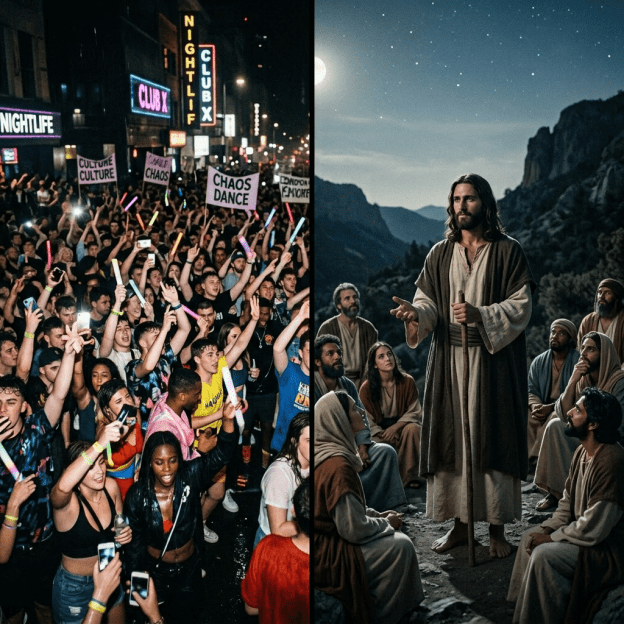
Crowd at a night club event with glow sticks and protest signs; barefoot man in biblical clothing holding a staff in a rocky mountainous landscape at night

The Serious Call to Discipleship

What does your life look like? Loaded question, I know. But, one that I would like us to think about seriously. When you evaluate – seriously evaluate – your life, every aspect of your life, what do you see? Does your life look like a person you try to imitate and emulate? Have you become so enamored with someone that you actually try to pattern your life according to what you see in them? Or, let’s think of it in larger terms. Perhaps your life looks like the culture around you. Perhaps you have chosen a lifestyle that is prominent in your cultural setting.

We are all disciples of someone or something. Oftentimes, probably more often than not, the term is used in reference to followers of Jesus Christ. But in reality, we become a disciple of whomever or whatever we follow, striving to be just like them or it. So, back to the first sentence in this blog: What does your life look like?

We make choices every day that answer this question. It can be something as simple as the choice of clothing we will wear, the places we will go, the people with whom we will spend time, the investment of our time, the investment of our resources, etc. Those are decisions we will make each day, and which will in large part define who we are, and yes, what we look like.

Now, think specifically about you. Take some time to look seriously at your life right now. Based on what you see, would you say that you are a serious-minded person in your resolve to be a disciple of Jesus Christ, or does your life bear more resemblance to the culture in which you live? Don’t pass over this question flippantly. Take enough time to give serious thought to your answer. Allow me to suggest a few things to consider which might be of assistance in your self-evaluation. For those of us who identify ourselves as disciples of Jesus Christ, let’s simply ask ourselves a few very specific questions.

First, does my life look more like a disciple of Christ or of culture in the area of my personal beliefs? Disciples of Jesus Christ should follow His teachings which are found in the Bible. Jesus took a hardline stand against sin. He took it so seriously that He gave radical instructions on how to deal with it. He said, “If your right hand causes you to sin, cut it off and cast it from you; for it is more profitable for you that one of your members perish, than for your whole body to be cast into hell.” (Matthew 5:30) Those are serious and sobering words. It is difficult to explain away what Jesus taught about what we should believe about sin.

Second, does my life look more like a disciple of Christ or of culture in the area of my personal behavior? Behavior, for the most part, is determined by your personal beliefs. The things we do are driven by what we believe about those things. Of course, it is possible to behave in a manner that is opposite of what we believe. A person can believe that adultery is wrong and still decide to engage in an adulterous relationship; or believe that dishonesty is wrong and yet decide to tell a lie because they feel that telling the truth would be harmful in some way. However, I do believe that our behavior is determined in large degree by what we believe. If the Bible teaches that a certain behavior is wrong, then believe it, and behave according to it.

Third, does my life look more like a disciple of Christ or of culture in the area of what I can and can’t condone? According to the Merriam-Webster Dictionary, to condone means to regard or treat (something bad or blameworthy) as acceptable, forgivable, or harmless. This has so many different nuances that we must be careful as to how we understand it. First of all, sin is forgivable. No matter what sin(s) a person has committed, God offers forgiveness. However, God does not condone sin. He never regards something bad or blameworthy as acceptable. If we are going to be sincere disciples of Jesus Christ then we must follow His lead. We are never to condone sin.

And yet, it seems that the acceptance of sinful behaviors and lifestyles has become the norm of our day, even within the confines of professing believers. To accept sinful behaviors and lifestyles is to live in disobedience to the clear teachings of Scripture. Thus, if we, as professing believers, condone and even approve of such behavior, then we are committing sin ourselves. We are living in disobedience to the teachings of our Lord.

I guess we could boil it all down to one simple question. I say it is simple, but it can become rather complex and profound when we begin to dissect the far-reaching ramifications of our answer. Will I be a true follower of Jesus Christ, or will I pick and choose what I want to believe and what I would rather discard? One of my professors at Criswell College in Dallas, TX, had a favorite saying that he used quite often in speaking of how one reads and studies the Bible. He said that far too many operated on the principle of the “Burger King hermeneutic. They want to have it their way.” Those who embrace this type of Bible interpretation pick and choose. They accept the parts of the Bible that are acceptable to them and reject those they dislike.

If we are to be sincere in our application of Bible truth, then we have no room for having it our way. We must have it God’s way. And when God’s Word says that something is sin, then it is sin, period. There is no room for debate or discussion. So, start naming those behaviors that are now completely acceptable in our culture, and then turn to Scripture to find out what God says about them. If our personal beliefs are contrary to God’s Word, then the only right thing for us to do is to change our minds to agree with God’s Word. Abortion, human sexuality, marriage, adultery, pre-marital sex, living together outside of the Biblical model of marriage, human biological design of male/female (and no others), all men are created equal and bear the image of God, therefore, every life matters, racism (there is only one race – the human race – and many ethnicities), the sanctity of life inside and outside the womb, the reality of heaven and hell, and the list goes on and on.

A sincere follower of Jesus Christ will not be persuaded by the pull of culture to compromise the clear teachings of Scripture with the whims, the ebb and flow, of culture. Rather, we will be counter-cultural. We will be change agents in a world that desperately needs the light of God’s revealed will through the pages of His inspired Word to once again be heralded from every person who claims to be a disciple of Jesus Christ.

So, what does your life look like right now? If it looks more like the culture around you than the Word of God within you, then repentance, a turning back to the clear teachings of Scripture, would be the only correct response. Are you willing to follow Him? Then do it – today!

Flag of the Federal Republic of the United States with eagle seal waving by the Capitol building

Historical Foundations of the U.S. Federal Constitutional Republic

These are days in which we are witnessing a mass shift in behavioral and belief systems. Cultural demands are causing a major movement toward the acceptance of certain beliefs and behaviors that at one time were viewed as totally unacceptable. These shifts are causing enormous inroads of erosion in political, philosophical, societal, and theological systems which were at one time held to be solidly grounded upon a strong foundation of accepted beliefs. Granted, when a belief is found to be erroneous, then it should be changed to meet the new-found data which warrants the change. But, as the old adage goes, “if it ain’t broke, don’t fix it!”

That old line of reasoning seems to have been discarded, with the acceptable new adage being, “if it ain’t broke, fix it anyway”, Or, even worse, “if it ain’t broke, break it, then fix it any way you like”. This last statement seems to be the common mode of operation among many today. Let’s give this observation some thought.

If you were to be asked what form of government the United States was founded upon, how would you answer? Wikipedia lists 35 different forms of government in the world today. However, there are three different terms that are used to describe the United States’ form of government, according to whom you may ask. Are we a democracy? Or are we a democratic republic? Or are we a federal constitutional republic? Let’s consider a brief definition of each of these terms.

First, a democratic form of government is one which is governed by the people. They exercise this supreme power either directly or indirectly, through elected officials. There are two main lines of democracy: direct democracy in which the people directly decide on any legislative decisions, or representative democracy, in which they elect officials to make decisions on their behalf, and according to their wishes.

Second, a democratic republic is a form of government that has elements of democracy and republicanism. It is in this form of government that power is held by the people, who then exercise their authority through elected representatives who cast their votes and make their decisions based on the will of their constituency. This form of government allows the people to have a voice and to personally participate in the decision-making processes that affect them, personally, and their communities, collectively.

And third, a bit different than the democratic republic, is the federal constitutional republic. In this form of government, power is divided between a national government, individual state governments, with the government operating under the dictates of a constitution that serves to protect individual rights. This form of government also brings into play certain elements of democracy in that individual citizens have the opportunity to influence government decisions through their ability to vote in elections, and also a republic, where their elected officials govern.

The United States has historically been defined by the federal constitutional republic. I say historically because in recent years it seems that we are struggling, as a nation, in deciding what form of government we actually are. Those who are presently fighting tenaciously to lead us to become governed by socialism are causing confusion among their constituents by introducing political platforms that are a far cry from anything that has ever been witnessed in this country. They are casting aside all historical precedents in order to start with a fresh, clean slate. By doing this, they are opening the doors to political policies and practices that are completely foreign to anything that has ever been part of the American political landscape.

Grandiose promises are made, with the hopes that these promises will compel voters to go to the voting precincts to cast their votes in favor of a political system that has proven to be disastrous in most of the countries in which it has been tried. As President Ronald Reagan stated so powerfully, “Socialism works only in heaven, where it isn’t needed, and in hell, where they’ve already got it.” And Margaret Thatcher’s famous remark, “The problem with socialism is that you eventually run out of other people’s money.”

The United States has operated successfully in all of its storied history as a federal constitutional republic. There are those who say it is a broken system that needs to be discarded. Others say it has some broken parts that need to be repaired. And still others who are demanding that it be dismantled completely and replaced with a socialist form of government. Those in this last category are striving to do this by rewriting our nation’s history, by destroying all vestiges of all historical markers of our past, and by introducing an entirely different system of national government.

For what it’s worth, my suggestion is that we identify those areas that do need reform, that we learn from our past, that we make necessary changes to solve the problem areas, and that we vote out those who would have the United States of America discard all of our history, all of our successes, all of our founding fathers dreams, visions and aspirations, to become what the vast majority of us DO NOT WANT. Those that would rather live under the political and governmental umbrella of a socialist country – well, they have plenty of other places to live. Instead of coming here and trying to change us, why not go back where you came from. If the form of government there was what you want, don’t try to impose it on us.

And, if our form of government is what you want, then we welcome you with open arms. Come, be one of us, assimilate into our way of life, but don’t come with the agenda of imposing your way of life on us. We like who we are, and plan to maintain what we have.

Large crowd celebrating America's 250th anniversary with Christian heritage theme and American flags

America at 250: The Importance of Faith in Our History

We are approaching the 250th anniversary of our nation. What a milestone this is – to celebrate our country’s long-standing existence as a nation which was founded on principles gleaned from the pages of Scripture. Read carefully, thoughtfully, and prayerfully these quotes from two men who were profoundly used of God in the ongoing march of our nation’s past.

I have lived, Sir, a long time and the longer I live, the more convincing proofs I see of this truth – that God governs in the affairs of men. And if a sparrow cannot fall to the ground without his notice, is it probable that an empire can rise without his aid? We have been assured, Sir, in the sacred writings that “except the Lord builds they labor in vain that build it.” I firmly believe this: and I also believe that without his concurring aid we shall succeed in this political building no better than the Builders of Babel. Benjamin Franklin

We have been preserved, these many years, in peace and prosperity. We have grown in numbers, wealth and power, as no other nation has ever grown. But we have forgotten God. We have forgotten the gracious hand which preserved us in peace, and multiplied and enriched and strengthened us; and we have vainly imagined, in the deceitfulness of our hearts, that all these blessings were produced by some superior wisdom and virtue of our own. Intoxicated with unbroken success, we have become too self-sufficient to feel the necessity of redeeming and preserving Grace, too proud to pray to the God that made us! Abraham Lincoln

Two giants from the pages of history; two testimonies of their belief in God, and of the nation’s desperate need to remain faithful to Him. But look closely at their words. Listen to their hearts as they warn those who were contemporaries with them, as well as those who would follow. The warning is clear, concise, and unmistakable: Remove God, and the nation will not survive! I don’t think either of them could have made their point any clearer. And please understand that this is only two examples out of many, many others that carry the same sentiment.

I wonder what they would say as their beloved nation draws near to its 250th anniversary. Would they recognize it? Would they be pleased with the state of the nation they so loved? Or would they lament what they would witness?

I certainly can’t speak for them, but I can, through quoting these statements, let them speak once again. I would recommend that you take a few minutes to reread the quotes above. I would suggest that we not allow ourselves to read them without thinking about the seriousness of their words. These two men gave a solemn word of warning to all that would follow after them in the ongoing march into the pages of history.

I would like to draw attention to this statement from Abraham Lincoln’s words: “But we have forgotten God.” Have we, today, forgotten God’s role in the establishment, and ongoing development, of the United States of America? Have we embraced a philosophy of life that is void of the clear teachings of Scripture? Are we now, as a nation, being guided by those in powerful political offices who embrace a philosophy of how our government should lead us into the future – without the God of the Bible even getting a passing glance as they stand on the philosophical and societal principles which would only lead our nation even further down a rabbit-hole that closely resembles Alice’s: A rabbit-hole in which we meet characters who claim to love America, but who disregard the precedents of our historical past. Especially those precedents which clearly establish the Judeo-Christian heritage and foundation upon which this nation was established.

My direst worry about our nation as we celebrate this huge milestone is that the God now being embraced by multitudes of our citizenry is not the God of the Bible. The “gods” of the present day are not God! They are either false gods of other religions, or they are man-made gods who only cater to our personal and, I might add, selfish desires.

Church steeples still dot the countryside of America. But fewer and fewer continue to stand staunchly on the principles which guided our leaders from the past to make such powerful statements as those quoted above. Will the United States of America survive the onslaught of philosophical, societal, and political change? Only God knows the answer to that question. And, He is our only hope!

So, I say, “Happy Birthday, America! Celebrate! Remember! Learn from those who blazed the trail to make America great. And God, please, make America great again by turning our hearts back to YOU!

White churches named Clear Grove, Bethesda, and Central on a winding road in a rural Appalachian landscape with fall colors

Why is There a Plurality of Protestant Denominations?

I am first and foremost, Christian, one who follows Jesus Christ. Therefore, I am a disciple of Jesus Christ. I strive to adhere to His teachings, as well as the overall message and teachings of the Bible. I strive to be obedient to the teachings of Scripture as I read, study, and submit myself to the authority of those teachings.

Second, I am a Baptist – I adhere to the doctrinal teachings of the Baptist faith. More specifically, I am a Southern Baptist. Therefore, I am a member of the Southern Baptist Convention, the South Carolina Baptist Convention, and the Moriah Baptist Association. My membership in these three entities is strictly on a voluntary basis. I am free to withdraw from being affiliated with any or all of them at my discretion. And, I might add, the denomination is free to withdraw fellowship from me if I should choose to denounce my belief in the guiding principles and the doctrinal beliefs of the denomination.

But now to the point of this blog. Why is there a plurality of protestant denominations? Where did they originate? Why do they have differing beliefs and practices? Why can there not be agreement between them? Church history proves that there have been, and continues to be, major doctrinal and theological concerns, as well as differences of church government, policy and polity. One might look at this varied tapestry of differences and wonder how they all came about if each of them take extreme effort in a serious interpretation of Scripture.

This has always posed quite a dilemma for me. My parents were Baptists, so I suppose the reason I joined a Baptist church initially is due to their influence. However, I can honestly say now that I am a Baptist because I have seriously considered the beliefs and church traditions of other denominations and still believe that Baptist doctrine is closer to the Bible’s teachings than the others. That is not to say that I, or anyone that I know, agrees totally with everything the Baptists believe. But the issues that I might take issue with are not of eternal consequence, so I might be a bit more flexible in taking a stand for my personal interpretation of a given text.

I have many friends and acquaintances who are members of churches of different denominations. We talk, we discuss, we debate, our differing beliefs, but we remain friends. I respect their views on doctrinal and theological issues, as they do mine. We have healthy conversations, sometimes even

At the end of the day, we simply acknowledge that we agree to disagree, but to disagree agreeably.

intense debates, on our different interpretations. And, at the end of the day, we simply acknowledge that we agree to disagree, but to disagree agreeably. We don’t throw our friendship out the window, casting aside long-standing relationships, due to a doctrinal disagreement. We simply agree that we are not going to agree.

Now, to be sure, if the discussion gravitates toward a subject of eternal significance, then we must agree. There are certain tenets of the Christian faith that must be acknowledged, accepted, and acted upon to even be a Christian. There can be no room for debate on those. But other matters that are not clearly explained, and lend themselves to different interpretations, must be discussed with a desire to learn, and even change, if the topic under consideration is explained in such a way as to change one’s mind on the meaning of the text.

I remember vividly (even though it has now been 47 years since) being a student in Dr. A.C. Miller’s class at Fruitland Baptist Bible College. He gave a list of books from which each student was to choose one to write a book report/review. However, for some unknown reason, he told me which book he wanted me to write a review of: J.I. Packer’s book, “Evangelism and the Sovereignty of God.” The book was written with the author’s attempt to explain how evangelism fits in with the sovereignty of God, or, to look at it from the opposite perspective, why evangelism is even important if God is sovereign.

I read the book – then I reread the book. I sincerely and seriously tried to grasp the deep theological significance of such a profound, thought-provoking attempt at explaining how both of these concepts could be taught side-by-side in the Bible, and yet be so diametrically opposite of each other. How is one to explain two ideas that are seemingly inexplainable and irreconcilable?

Since my first encounter with this book, I have read it at least a dozen more times. I can’t say that I have yet grasped it all, but I was profoundly impressed and theologically challenged by what I read. I say all that to say this: My personal beliefs concerning God’s sovereignty, and the Bible’s emphasis on evangelism, were permanently altered by Packer’s insights. I have since read numerous other books that delve into this theological debate, but it was “Evangelism and the Sovereignty of God” that laid a solid foundation for my personal belief.

The point? Packer’s insights are not Baptist. But they are Biblical. So, do I choose to hold onto Baptist belief on the subject, or do I change my Baptistic training to fit with Scripture? Can I remain Baptist if I adhere to a non-Baptist point of doctrine?

The bottom line for me is that we all need to be sincere, serious students of God’s Word and let that determine what we believe on any given doctrinal/theological issue. Be true to that Word, over and above what anyone else might say. However, a closing word of warning. Be sure that you are using sound hermeneutical skills in the interpretation of Scripture. The Bible will never contradict itself, so don’t make a passage mean something when the overall message of Scripture teaches something else.

So, be a good representative of your particular denomination’s doctrinal beliefs. As the Apostle Peter encouraged, be ready always to give a reason for the hope that is within you. Have a ready defense of the Gospel. But be respectful of the beliefs of others. Have healthy conversations. Don’t be afraid to discuss your beliefs with someone who holds to a different interpretation. Converse with the idea that there is something we can learn from one another. We will be better for it.

Remember: Iron sharpens iron. Let’s give ourselves to the task of sharpening one another in the Word, ways, and will of God.

Blessings!

Bill C-9 titled Act to Amend the Canada Elections Act with Parliament building in background

Is Bill C-9 a Threat to Biblical Teachings in Canada?

In the last few days I have noticed a good number of people posting on Facebook that Canada has criminalized the Bible. I have tried to find validation for these claims, and have now found several interesting articles relating to Bill C-9 which has been introduced to their house of commons. Every article I found states the same thing: Bill C-9 does not criminalize the Bible, but, in my estimation, it does present an extremely slippery slope headed in the wrong direction. For the sake of clarity, let me share a statement from an article entitled, “What Bill C-9 Actually Does.”

Bill C-9 aims to strengthen Canada’s response to hate-related incidents, including antisemitism. The amendment in question removes a specific defense in the Criminal Code for statements made in good faith based on religious texts, but it does not make quoting Scripture a crime. Religious discussion, debate, and sharing of biblical passages remain legal, unless they willfully promote hatred against an identifiable group.

The reason I believe this to be a slippery slope headed to destructive ends is because of the underlying intent that could be read into this statement. Look again at the last sentence in the statement quoted above. Read it carefully. Make special note of the word, “unless.” There is the slippery slope. There is the possible destructive end to which this bill could lead.

Let’s think of a hypothetical end result of this bill. Suppose on a given Sunday morning, in a typical, conservative, Bible-believing church, the pastor preaches a message on human sexuality. He isn’t targeting the subject. He is preaching expositionally through the Bible, and the text of the week is as follows:

“Therefore God also gave them up to uncleanness, in the lusts of their hearts, to dishonor their bodies among themselves, who exchanged the truth of God for the lie, and worshiped and served the creature rather than the Creator, who is blessed forever, Amen. For this reason God gave them up to vile passions. For even their women exchanged the natural use for what is against nature. Likewise also the men, leaving the natural use of the woman, burned in their lust for one another, men with men committing what is shameful, and receiving in themselves the penalty of their error which was due.” Romans 1:24-27

In this text, Paul mentions only two sexes – male and female. He also mentions the “natural” as opposed to that which is “against nature.” And what specifically does he single out, for illustration of his premise that they “exchanged the truth of God for the lie”? Unnatural sexual behavior. This would include much of today’s emphasis of the 2SLGBTQI+ acronym, which identifies “sexual orientations.” Notice the “+” at the end. Just in case your personal sexual orientation is not covered with the other letter significations, you can add yours here!

Now, suppose that as the preacher delivers his message, there happens to be in the congregation someone who identifies as bisexual. He is offended at the words the pastor is using, steps outside, calls the police, reports the pastor for “hate speech”, to which police are dispatched and then make their way to the church. They enter the church, making their way up the aisle toward the pastor, who continues with his message. They step up on the platform, one of either side of the pastor, where one of them says, “You are spewing hate speech, which could incite riotous action. We must ask that you stop immediately, or you will be arrested for attempting to instigate a riot.”

Now, please remember that this is all hypothetical. But would you not agree that the trajectory for something like this is not a baseless interpretation of a possible scenario taking place? Those who have voted on this bill may think that they are doing a great service to the civility of their citizens, but they are really opening a Pandora’s box of terrible end results of their decision.

Paul stated in the fourth chapter of his first letter to Timothy the following:

Now the Spirit expressly says that in latter times some will depart from the faith, giving heed to deceiving spirits and doctrines of demons, speaking lies in hypocrisy, having their own conscience seared with a hot iron, forbidding to marry, and commanding to abstain from foods which God created to be received with thanksgiving by those who believe and know the truth. 1 Timothy 4:1-3

Note particularly that Paul is speaking of those who have departed from the faith, having been deceived. In the previous passage quoted above he said that they had exchanged the truth of God for the lie. I believe that this suggest Bill C-9 is much more dangerous than the outright criminalization of the Bible. I believe (maybe in absolute naivete) that if a bill to make the Bible illegal were introduced it would be immediately derailed. But this is a more subtle, seemingly innocuous, bill for everyone’s protection. Well, not necessarily for everyone. Christianity will suffer the ultimate blow from such a bill.

Could I suggest that prayer be lifted for the citizens of Canada? It would be fitting for us to lift their national leaders in their decision-making process to weigh carefully the far-reaching ramifications of this bill. And could we add our own nation to that prayer list, if it is not already there? Our nation is following in the tracks of many other nations before us. Nations that were once bastions of the Christian faith, and now, sadly their countrysides are dotted with empty buildings which were at one time thriving houses of worship. Pray that this will not be the epitaph written across the gravestone of a dead nation. Oh, God, have mercy!

Understanding Life’s Unfairness: Balancing Good and Bad

Bad things happen to good people. Good things happen to bad people. Bad things happen to bad people. Good things happen to good people. We, as members of the human race, are prone to experience both good and bad, regardless of whether we are good or bad. Life experiences are the common lot of life.

Granted, it seems that some experience more than their fair share of bad, while others seem to experience an overabundance of good. Some seem to have been born for adversity, while others seem to have been born with the proverbial golden spoon in their mouth. Why? That is the age-old question, right? Why does like seem to be so out of balance?

We’ve probably all known some who were prone to experience only bad. It’s like that song from the “Hee Haw” variety show from long ago. The lyrics would be funny if there was not so much truth in them. Do you remember? The chorus sticks in my memory banks even though I haven’t heard it in many, many years:

Gloom, despair, and agony on me

Deep, dark depression, excessive misery

If it weren’t for bad luck, I’d have no luck at all

Gloom, despair, and agony on me.

Have you known someone whose picture could be posted beside these lyrics? Perhaps you even view yourself in such terms. Perhaps you are one of those who is always looking at others, with their well filled “bags”, wondering why they have all the “good luck” when your bag is, like Charlie Brown’s, always filled with rocks. Maybe you live each day wondering when your ship is going to come in. And yet, every day, day-after-day, your ship never appears on the horizon.

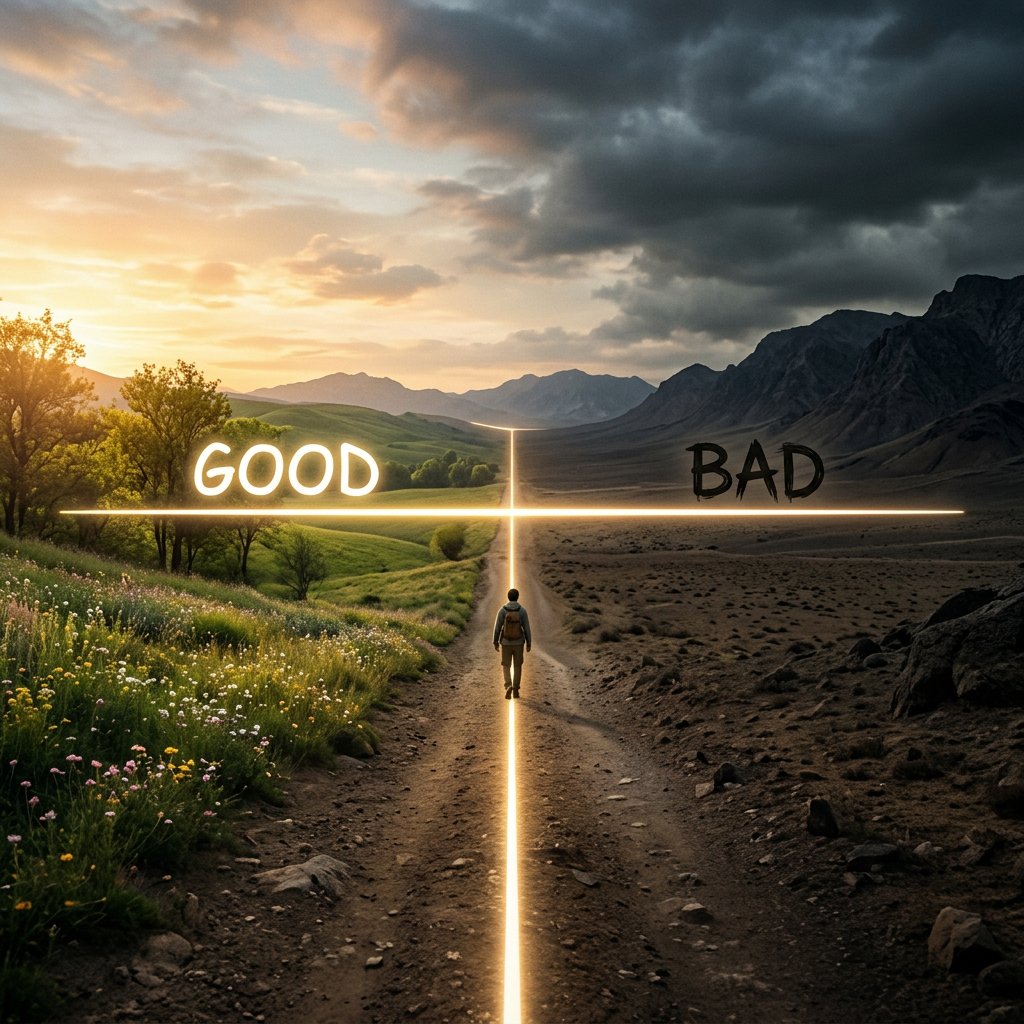
If someone asked you to explain what “life isn’t fair” means, how would you respond? As you think about your own life, right now, whatever season of life you happen to be in, would you describe it as one who has been the recipient of more good than bad; more bad than good; better than you deserve; worse than you deserve? Where would you fall on the line representing the spectrum between good and bad?

Person walking a dirt path split by lighted lines into a green, sunny side labeled GOOD and a dark, rocky side labeled BAD

For the sake of clarification, let’s perform a little experiment. Take a pencil and sheet of paper, dividing the sheet of paper into two columns. Now, think about your life up to this point. Would you say that you have experienced more good than bad? Then on the left side, begin making a list of the good things that have happened in your life. Think of big things and little things – as many as you can in five minutes.

Once you have completed that list, then begin a second list. This list should consist of the bad things that have happened to you. Make these two lists as extensive as possible.

Now, once both lists are completed, and you feel that you have made a pretty comprehensive list of both, then take a few more minutes to compare the two lists. Not so much this time in trying to go back through every entry individually, but look at the list as a whole. How long is the good list? How long is the bad list?

You see, the point of this exercise is not to look at the items one by one, but to see that your life, just like everyone else’s, is an ongoing saga of episodes of good and bad. Granted, some will have more on one side than the other, but there will be entries on both, if we have been totally honest.

So, what’s the point? The point is simply that we should live every day, each day, one day at a time. We often worry about tomorrow’s “bad”, while at the same time trying to live “In” yesterday’s “good.” Life just doesn’t work that way. God’s grace for today is sufficient for today. He will supply sufficient grace for tomorrow, tomorrow. So don’t try to deal with what might happen tomorrow before tomorrow gets here. We may find that we have carried the weight of what we thought would happen tomorrow, but it never materializes. Just rest assured that His grace is sufficient for what we are facing at any given time, but not for what “may happen” sometime in the future.

The Apostle Paul had some problem that he described as a “thorn in the flesh.” He did not elaborate on what that thorn was, but he said that he prayed three times, asking God to remove it. God’s response to Paul was that He was not going to remove the thorn, but that His grace would be sufficient to carry it. Maybe you can relate. Maybe you have some “thorn”, and you have been asking God to remove it. Yet, you are still suffering the weight of that thorn. Rest assured: God’s grace is sufficient for you to bear it, and if, at some point in the future, God decides to remove it, you will find that He has used that thorn in ways to minister to others in ways He could not have had He removed the thorn at any previous time.

God always knows best; God always does best! And, yes, His grace is more than enough,

Parched cracked earth in foreground with mountains and rainstorm in background under grey cloudy sky.

Understanding Drought: Biblical Insights on Rain

It is so very easy to take things for granted. Rain, for example, is never really thought much about until it doesn’t! As I write this blog I am listening to the rain falling outside. It is a beautiful sound, indeed. We have been suffering the ravages of a prolonged drought in the southeastern part of the United States that has persisted for quite a while. We have just been issued a water use restriction due to the water levels reaching very serious conditions. A few weeks without any moisture falling from the skies can result in severe water shortages. When it rains according to the seasonal norms we probably don’t give much thought to it, but when those seasonal norms fail, and the ground begins to crack from the lack of moisture, then we all of a sudden recognize the looming problem.

If the lack of rain continues to worsen, and the ground continues to crack from the severe conditions, then we begin to do what should have been done from the very beginning: pray. Pray to the God who is in control of the rain. Oh, I know. The skeptics among us are already recoiling at the thought of praying for rain. After all, why should we have to beg God to open the heavens and send forth a bountiful rainfall when He has promised to supply all our needs? Hasn’t He promised to care for us, and to provide for us? Then why, why do we need to ask for it?

The Bible offers several possible answers to that question. Some we may not want to hear, but the lessons are in Scripture all the same. Allow me to share a few of those Biblical responses to explain the “why” of a withholding of rain.

First, in relation to the nation of Israel, which was in a covenant relationship with God, God made a conditional promise to them concerning, among other things, rainfall. Listen to the words penned by the prophet Amos:

I also withheld rain from you, when there were still three months to the harvest. I made it rain on one city, I withheld rain from another city. One part was rained upon, and where it did not rain the part withered. So two or three cities wandered to another city to drink water, but they were not satisfied. Yet you have not returned to Me,” says the Lord. Amos 4:7-8, emphasis added

Due to the fact that the nation had broken their end of the covenant with God, He had caused the drought to ravage the land. When this act of natural disaster did not result in bringing the people to repentance, God had to resort to other measures. So, sometimes periods of drought and other natural disasters are a direct result of national sinfulness.

Second, there are times when storms of nature are a simple result of the curse God pronounced on the earth when Adam and Eve rebelled in disobedience against God. There are times in which a storm – be it a tornado, hurricane, flood, etc. – happens due to the fact that the natural realm has been adversely affected by the ravages of humankind’s sin. This curse of God on the earth will continue, and perhaps even intensify, with the passing of time. This will not end until Jesus comes and corrects all the wrongs caused man’s rebellion against the God of the universe. Paul even says this:

For we know that the whole creation groans and labors with birth pangs together until now. Romans 8:22

He is speaking of the reality that the earth itself is suffering because of the consequences of God’s judgment on man’s rebellion. Thus, many times storms are just a part of living in a fallen, sin-cursed world.

A third possible reason for the withholding of rain, among other natural disasters, is that God uses them to draw attention to spiritual drought. When a nation that once was committed to God, to the teachings of His Word, with a desire to fulfill His will, becomes cold, indifferent, complacent and even apathetic, then God may use the withholding of rain trying to draw that nation back to Himself. Again, as one reads the pages of the Old Testament this is a recurring reason for God sending natural disasters of varying severity. This is a remarkable display of His love for His children. He loves us enough to never leave us in a state of rebellion but will always use whatever means necessary to draw us back to Him.

What a sweet, sweet sound it has been today to hear the falling of the rain. Plants, flowers, vegetables planted in our gardens, all have their “mouths” turned heavenward, drinking in the nourishment from the skies. Withered leaves on those plants are already beaming with newly realized strength and vitality. Nature itself, having been ravaged in recent weeks by the lack of rain, are now being renewed. All because God has visited our land once again with the rains we so much needed and now have received.

One final word. If you happen to live in this area of drought, have you taken time in the last few days to thank God for the bountiful rainfall that we have now enjoyed? Whether the rainfall has been a direct result of God’s activity, or if it has been just the course of the natural occurrence of things according to God’s creative design, it is still very appropriate to pause and lift a voice of gratitude to the One who is the Provider of the early and the latter rains. He is always right on time!