Tag Archives: jesus

Understanding Life’s Unfairness: Balancing Good and Bad

Bad things happen to good people. Good things happen to bad people. Bad things happen to bad people. Good things happen to good people. We, as members of the human race, are prone to experience both good and bad, regardless of whether we are good or bad. Life experiences are the common lot of life.

Granted, it seems that some experience more than their fair share of bad, while others seem to experience an overabundance of good. Some seem to have been born for adversity, while others seem to have been born with the proverbial golden spoon in their mouth. Why? That is the age-old question, right? Why does like seem to be so out of balance?

We’ve probably all known some who were prone to experience only bad. It’s like that song from the “Hee Haw” variety show from long ago. The lyrics would be funny if there was not so much truth in them. Do you remember? The chorus sticks in my memory banks even though I haven’t heard it in many, many years:

Gloom, despair, and agony on me

Deep, dark depression, excessive misery

If it weren’t for bad luck, I’d have no luck at all

Gloom, despair, and agony on me.

Have you known someone whose picture could be posted beside these lyrics? Perhaps you even view yourself in such terms. Perhaps you are one of those who is always looking at others, with their well filled “bags”, wondering why they have all the “good luck” when your bag is, like Charlie Brown’s, always filled with rocks. Maybe you live each day wondering when your ship is going to come in. And yet, every day, day-after-day, your ship never appears on the horizon.

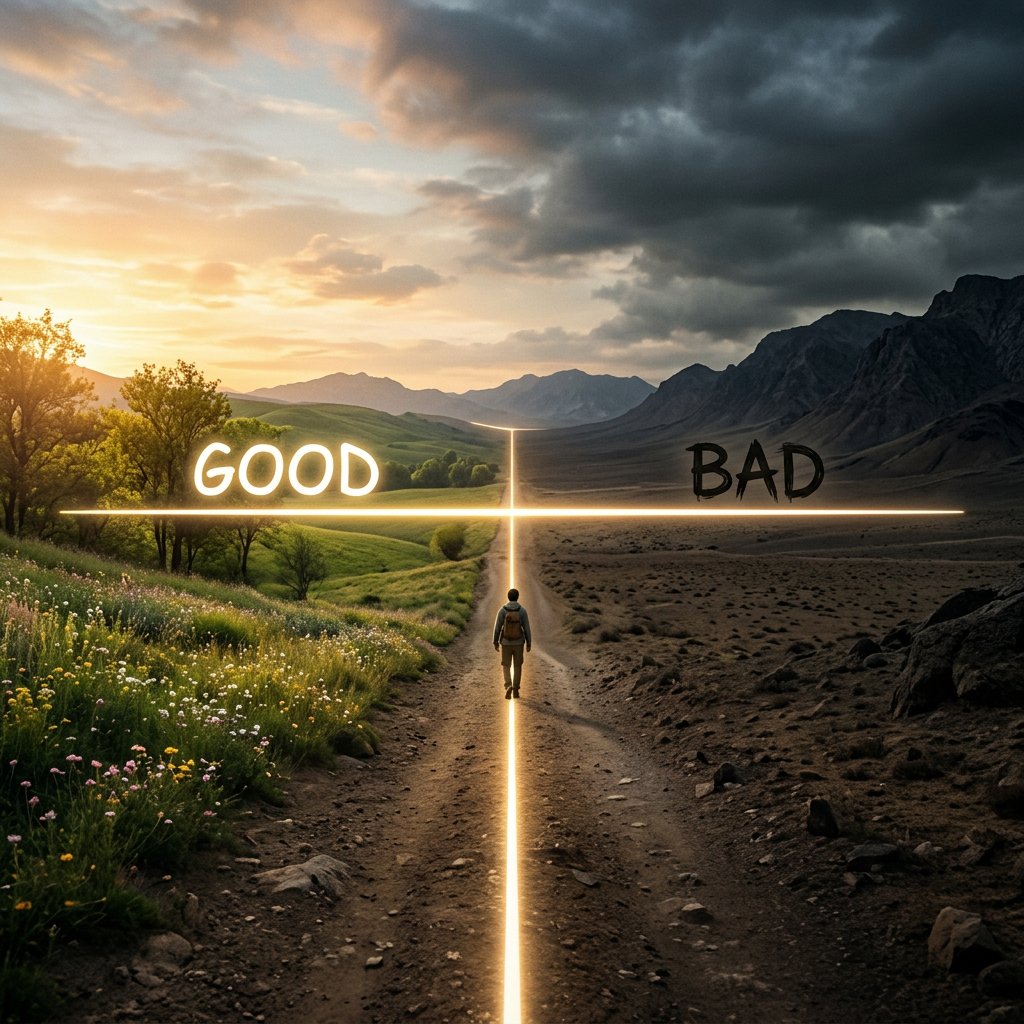
If someone asked you to explain what “life isn’t fair” means, how would you respond? As you think about your own life, right now, whatever season of life you happen to be in, would you describe it as one who has been the recipient of more good than bad; more bad than good; better than you deserve; worse than you deserve? Where would you fall on the line representing the spectrum between good and bad?

Person walking a dirt path split by lighted lines into a green, sunny side labeled GOOD and a dark, rocky side labeled BAD

For the sake of clarification, let’s perform a little experiment. Take a pencil and sheet of paper, dividing the sheet of paper into two columns. Now, think about your life up to this point. Would you say that you have experienced more good than bad? Then on the left side, begin making a list of the good things that have happened in your life. Think of big things and little things – as many as you can in five minutes.

Once you have completed that list, then begin a second list. This list should consist of the bad things that have happened to you. Make these two lists as extensive as possible.

Now, once both lists are completed, and you feel that you have made a pretty comprehensive list of both, then take a few more minutes to compare the two lists. Not so much this time in trying to go back through every entry individually, but look at the list as a whole. How long is the good list? How long is the bad list?

You see, the point of this exercise is not to look at the items one by one, but to see that your life, just like everyone else’s, is an ongoing saga of episodes of good and bad. Granted, some will have more on one side than the other, but there will be entries on both, if we have been totally honest.

So, what’s the point? The point is simply that we should live every day, each day, one day at a time. We often worry about tomorrow’s “bad”, while at the same time trying to live “In” yesterday’s “good.” Life just doesn’t work that way. God’s grace for today is sufficient for today. He will supply sufficient grace for tomorrow, tomorrow. So don’t try to deal with what might happen tomorrow before tomorrow gets here. We may find that we have carried the weight of what we thought would happen tomorrow, but it never materializes. Just rest assured that His grace is sufficient for what we are facing at any given time, but not for what “may happen” sometime in the future.

The Apostle Paul had some problem that he described as a “thorn in the flesh.” He did not elaborate on what that thorn was, but he said that he prayed three times, asking God to remove it. God’s response to Paul was that He was not going to remove the thorn, but that His grace would be sufficient to carry it. Maybe you can relate. Maybe you have some “thorn”, and you have been asking God to remove it. Yet, you are still suffering the weight of that thorn. Rest assured: God’s grace is sufficient for you to bear it, and if, at some point in the future, God decides to remove it, you will find that He has used that thorn in ways to minister to others in ways He could not have had He removed the thorn at any previous time.

God always knows best; God always does best! And, yes, His grace is more than enough,

Parched cracked earth in foreground with mountains and rainstorm in background under grey cloudy sky.

Understanding Drought: Biblical Insights on Rain

It is so very easy to take things for granted. Rain, for example, is never really thought much about until it doesn’t! As I write this blog I am listening to the rain falling outside. It is a beautiful sound, indeed. We have been suffering the ravages of a prolonged drought in the southeastern part of the United States that has persisted for quite a while. We have just been issued a water use restriction due to the water levels reaching very serious conditions. A few weeks without any moisture falling from the skies can result in severe water shortages. When it rains according to the seasonal norms we probably don’t give much thought to it, but when those seasonal norms fail, and the ground begins to crack from the lack of moisture, then we all of a sudden recognize the looming problem.

If the lack of rain continues to worsen, and the ground continues to crack from the severe conditions, then we begin to do what should have been done from the very beginning: pray. Pray to the God who is in control of the rain. Oh, I know. The skeptics among us are already recoiling at the thought of praying for rain. After all, why should we have to beg God to open the heavens and send forth a bountiful rainfall when He has promised to supply all our needs? Hasn’t He promised to care for us, and to provide for us? Then why, why do we need to ask for it?

The Bible offers several possible answers to that question. Some we may not want to hear, but the lessons are in Scripture all the same. Allow me to share a few of those Biblical responses to explain the “why” of a withholding of rain.

First, in relation to the nation of Israel, which was in a covenant relationship with God, God made a conditional promise to them concerning, among other things, rainfall. Listen to the words penned by the prophet Amos:

I also withheld rain from you, when there were still three months to the harvest. I made it rain on one city, I withheld rain from another city. One part was rained upon, and where it did not rain the part withered. So two or three cities wandered to another city to drink water, but they were not satisfied. Yet you have not returned to Me,” says the Lord. Amos 4:7-8, emphasis added

Due to the fact that the nation had broken their end of the covenant with God, He had caused the drought to ravage the land. When this act of natural disaster did not result in bringing the people to repentance, God had to resort to other measures. So, sometimes periods of drought and other natural disasters are a direct result of national sinfulness.

Second, there are times when storms of nature are a simple result of the curse God pronounced on the earth when Adam and Eve rebelled in disobedience against God. There are times in which a storm – be it a tornado, hurricane, flood, etc. – happens due to the fact that the natural realm has been adversely affected by the ravages of humankind’s sin. This curse of God on the earth will continue, and perhaps even intensify, with the passing of time. This will not end until Jesus comes and corrects all the wrongs caused man’s rebellion against the God of the universe. Paul even says this:

For we know that the whole creation groans and labors with birth pangs together until now. Romans 8:22

He is speaking of the reality that the earth itself is suffering because of the consequences of God’s judgment on man’s rebellion. Thus, many times storms are just a part of living in a fallen, sin-cursed world.

A third possible reason for the withholding of rain, among other natural disasters, is that God uses them to draw attention to spiritual drought. When a nation that once was committed to God, to the teachings of His Word, with a desire to fulfill His will, becomes cold, indifferent, complacent and even apathetic, then God may use the withholding of rain trying to draw that nation back to Himself. Again, as one reads the pages of the Old Testament this is a recurring reason for God sending natural disasters of varying severity. This is a remarkable display of His love for His children. He loves us enough to never leave us in a state of rebellion but will always use whatever means necessary to draw us back to Him.

What a sweet, sweet sound it has been today to hear the falling of the rain. Plants, flowers, vegetables planted in our gardens, all have their “mouths” turned heavenward, drinking in the nourishment from the skies. Withered leaves on those plants are already beaming with newly realized strength and vitality. Nature itself, having been ravaged in recent weeks by the lack of rain, are now being renewed. All because God has visited our land once again with the rains we so much needed and now have received.

One final word. If you happen to live in this area of drought, have you taken time in the last few days to thank God for the bountiful rainfall that we have now enjoyed? Whether the rainfall has been a direct result of God’s activity, or if it has been just the course of the natural occurrence of things according to God’s creative design, it is still very appropriate to pause and lift a voice of gratitude to the One who is the Provider of the early and the latter rains. He is always right on time!

Elderly couple holding hands walking in hallway of care facility with nurse and residents in background

The Impact of Alzheimer’s: Love and Loss

One of the many wonderful attributes God placed in His human creation is the ability to remember. Can you imagine how horrible it would be if we did not have this remarkable God-given trait? It’s really impossible to even begin to understand the gravity of not being able to remember.

There have been movies that have tried to depict how tragic this would be. Just think how it would be to awaken every morning with no recollection of who you are, of the names of loved ones, of where you are, of what you do. It would be tragic, to say the least.

Sadly, there are multitudes who experience just such a reality. We all probably know of someone, or have heard of someone, who is struggling with Alzheimer’s or dementia. In serving as pastor for over forty years, I have known several, all of whom have left an indelible impression on me. It is with the utmost of compassion and love that I share some of their stories.

The first was a long-time follower of Jesus Christ. She, by the testimony of her life as well as her voice, was a vibrant witness for the Lord she loved so dearly. As she began to show signs of the beginning stages of Alzheimer’s, it was obvious that she was rapidly moving into that state of mental loss. At first she began to forget things. She couldn’t remember recipes of dishes she had prepared probably hundreds of times. Then, she began to forget names. At first it was just the names of acquaintances, but soon it included the names of close family members. She soon forgot the names of all her children.

Strangely enough, she never forgot the words to the hymns she had loved and sang for many years. A cassette player was kept by her bedside that played those old hymns constantly -all day and all night. She sang along with every one, usually with a huge smile on her face. The strangest thing to me was that, even though she could not remember who her children were, she never forgot me. Every time I would go visit, as soon as I walked in the door, she would have the biggest smile, and immediately say, “Preacher!” Why? I have no clue. I, for some unknown reason, was a memory lodged deeply in the recesses of her mind. Her family stood by her side faithfully, caring for her, tending to her every need, until the day the Lord called her home to be with Him – the One she had long awaited.

Another example was a couple in a church I served as pastor in Texas. Soon after I began my tenure there, one of the members asked me if I would like to meet his wife. I had noticed that he came to church alone, and wondered if he were married, and if so why his wife did not attend with him. I told him that I would be honored to meet her, so he made arrangements to pick me up one day the following week.

He had not told me anything about his wife, until I got into his truck and headed down the road. He then shared with me that she was in a nursing facility, where she had been for several years. He began to relate to me, with tears flowing down his cheeks, about seeing the first signs of what he came to realize was the onset of Alzheimer’s. It was small things at first, things that were easily dismissed as simple forgetfulness. But it soon became obvious that something much more serious was happening.

He cared for her in the home until it became painfully obvious that her needs were much more than he could handle. Reluctantly, he came to the conclusion that in order for her to be cared for in the most loving way, he would have to find a facility in which she could get the professional help necessary.

This couple was the greatest example of marital love I have ever seen. Three times every day he would go to the nursing facility – eight o’clock every morning, at noon, and again at five o’clock every evening. He would take her by the hand, walk her through the hallways, feed her each meal, all the while reassuring her of his deep and abiding love for her. She never responded, not even the slightest nod of the head or a squeeze of the hand. But relentlessly, come what may, he was there, telling her how beautiful she was and how much she was loved.

I wonder sometimes why God chooses to leave someone here, in this life, when it appears to us that they would be far better if He would call them to be with Him. And, the fact of the matter is, we usually don’t know. But we do know that God has His reasons, and that His ways are always right.

I think oftentimes about my own mother. She was showing the early signs of Alzheimer’s, and I knew that the day would come that I would walk into her room, and she would not know me. I prayed that day would never come, but it did. And as much effort as I had put into trying to prepare myself for that day, I was still so very ill-prepared. As I walked into her room and saw her sitting on the edge of her bed, I looked into her eyes and knew – I knew. It was a blank stare looking back at me. Her eyes were pools of darkness. She looked, she stared, and I knew in my mind that she was trying so very hard to remember.

I walked over and sat in a chair directly in front of her. I simply said, “Do you remember me?” “No. I don’t think so,” was the earth-shattering answer. I sat in stunned silence for a few seconds – an eternity. I tried to jog her memory by asking simple questions about family. “Have you ever been married.” “Do you have any children?” “Do you know where you are?” “No.” “No.” “No.” was her response to each.

It was one of the worst days of my life. Thankfully she did not stay in that mental state, but would have days of mental clarity which we all cherished. But we knew that her mind would never be like it had been. From that day until the day of her death, I cherished the moments I had with her so much more, putting forth every effort to help her maintain her dignity of life, but also to just let her be her, and take in every moment.

Life – a precious gift from God. Life- a brief span of time we spend on earth. Life – to be cherished and enjoyed. Life – deserving of the dignity God intended, because every life is a person created in His image.

Death – the inevitable path we all must follow. Death – the passage from this physical life into eternal life. Death – for the believer, the ultimate realization of the very presence of God. Death – not to be feared, because it has been swallowed up in victory.

“O death, where is your sting? O hades, where is your victory? The sting of death is sin, and the strength of sin is the law. But thanks be to God, who gives us the victory through our Lord Jesus Christ.” First Corinthians 15:55-58

Let’s treat every person we meet with the dignity they deserve. Let’s never allow strength or weakness, health or sickness, wealth or poverty, or any other man-made distinction to cause us to think more of one and less of another. Let’s love, and love, and love, and keep on loving. One day, if we live long enough, we will outlive many that we love. Let’s let our love for them be as Jesus’ love for His disciples:

“Now before the Feast of the Passover, when Jesus knew that His hour had come that He should depart from this world to the Father, having loved His own who were in the world, He loved them to the end.” John 13:1

Stone church with crumbling steeple and broken statue near sign about faith erosion and disbanded congregation

The Impact of Erosion on America’s Religious Identity

Erosion. Slow. Inconspicuous. Imperceptible to the human eye. Things appear to be changeless, but in reality, they are in a constant state of change – steady, methodical, relentless. Given enough time, erosion has the power to change the landscape. Boulders that once stood dauntless, seemingly in a state of permanence, giving the appearance of being unchangeable, are reduced to small, insignificant rocks, that can easily be picked up by a human hand, thrown across the surface of a tranquil lake, making several skips over the surface before finally sinking to the bottom, where it will continue undergoing more erosion as the movement of the water continues to perform the work of erosion.

There is not only the reality of the work of erosion in the natural world, but also in the cultural, political, societal, and religious beliefs and practices of any given nation. The imperceptible work of cultural erosion changes with the passing of time, and before we realize what is happening, we are living in a nation with cultural practices that were foreign to us just a few years earlier. The same is true in the political, societal, and religious elements that give a nation its distinctive character. It only takes nothing more than a cursory look at our past to see how the work of erosion has changed the landscape of life in the United States.

When our nation was founded, those who had the vision of leaving the religious oppression of England had the dream of beginning fresh, with the idea of religious freedom as one of the major driving forces behind their audacious and outlandish actions. It was in 1620 that the Mayflower landed in what became known as Plymouth Colony. From that very meager beginning came one of the most powerful nations that has ever existed in the history of the world.

Early in our nation’s history, it was clearly evident that those who came across the ocean in the Mayflower, as well as those who followed in their footsteps, were intent on establishing a nation which would be guided by Biblical principles. Many statements by early national leaders made it abundantly clear that the new nation would be a Christian nation. This certainly did not mean that every individual person in the nation at that time, or any time subsequent, would embrace the Christian faith. But regardless of an individual’s choice of religious belief, the nation would be established and guided by Biblical principles.

For a while, the fact that our founding fathers identified the nation as a Christian nation was evident. Classrooms across the land used the Bible as a major source of the education process. Colleges were established for the training of those who sought to be preachers and teachers. Hospitals were built, oftentimes funded entirely by Christian philanthropists. Every aspect of life in the new country was directly affected by Christian principle.

Religious erosion then began its subtle, slow, methodical, relentless work of changing the religious landscape of the newly founded nation. It was inconspicuous at first, but over time it began to show. It has continued its assault on the religious landscape of the United States and has now achieved its destructive end. This was assertively and adamantly stated by a previous president. Barack Obama, in a statement made during a press conference in Turkey, the former president said, “The United States is not a Christian nation, but rather a nation of citizens who are bound by shared ideals and values.”

“The United States is not a Christian nation, but rather a nation of citizens who are bound by shared ideals and values.”. Barack Obama

Again, I state the obvious: being a Christian nation does not necessitate that every individual citizen of that nation embraces the Christian faith, but that they recognize and accept the fact that the overriding fabric of the nation is guided by Christian principles. That is the way it was, but it is no longer the way it is. There are so many now who call the United States home, who have no respect for our Christian heritage. Instead of coming to our nation with the desire and the willingness to assimilate into our established way of life, they now come expecting citizens of our nation to bow to their religious beliefs, their cultural traditions, their laws. They would have us become like them, embracing their manner of life.

So how far are we to go in welcoming them? Should we simply acquiesce to their beliefs and behaviors? Do we lose our identity in order to make them feel welcome? I strongly suggest that would be – actually, already has been – the erosive work of religious and cultural persuasion. Our country is losing its identity. So much so, in fact, that former president Obama makes that assertive statement quoted above.

Jesus taught His disciples that the world would hate them because of their identification with Him. Christians are being maligned and mistreated, simply because they adhere to Jesus’ teachings, and strive to live for Him. He taught us to go into the world, sharing with others His immense love and grace, showing the way to escape spiritual darkness by coming into His light. However, as we look at the direction of many mainline protestant denominations, we see clearly the effects of the erosive work of religious adaptation. We no longer stand on the Bibie as our final authority. We allow other factors to take precedence over the teachings of our Lord.

We are warned in the Bible to be very careful as to whom we listen, and where we turn to get our convictions and make our commitments. The apostle John warns about spiritual warfare in which we engage when we stand for Biblical truth. He said that we must test the spirits to see if they are from God, or from some other source. However, it seems to me that many are not only not testing the spirits but are actually welcoming them into our local churches as well as into our denominational beliefs and practices.

I believe it is time – past time – to take a stand against the onslaught of religious erosion. It is time for us to stand up against the spirits of those who oppose clear teachings of Scripture and stand up for Biblical truth. It is, after all, our only source of absolute truth. It could be costly, but our Lord deserves nothing less than our total commitment to Him.

Person silhouetted on rocky mountain with glowing light and star-filled night sky

Understanding the Seasons of Life

Seasons: Winter, Spring, Summer, Fall. They come and go with amazing accuracy. Our calendars mark the first day of each season. For those who live in parts of the world where the seasons have abrupt and distinct changes in weather patterns, temperatures, precipitation, length of days, there is no uncertainty about what season of the year it is.

The changing of the seasons in nature reminds us of the different seasons which are clearly delineated in the human life cycle.

The changing of the seasons in nature reminds us of the different seasons which are clearly delineated in the human life cycle. From the moment of conception to the moment of death, all humans go through these seasons. Of course, we realize that some experience physical death before they go through all the seasons, but for those who live into the golden years, the reality of the changing of the seasons of life is clearly observed.

Human life progresses through what are often referred to as distinct stages, going from the prenatal stage to old age. Each stage is marked by changes that are unique to the particular stage one happens to be in. You can find the different stages of human development in many sources, with some variations according to the source to which you refer, but for the sake of this blog we will think of the stages as: 1. Prenatal stage; 2. Infancy; 3. Toddler; 4. Early childhood; 5. Middle childhood; 6. Adolescence; 7. Early adulthood; 8. Middle adulthood; and 9. Late adulthood.

Each of these seasons presents its unique physical, cognitive and emotional changes and challenges. There are abnormalities that can affect one’s experiencing these changes and challenges, but for the vast majority of humans, the seasons of life are distinct and easily recognizable. (Please note: even those born with some birth defects that interfere with the normal progression of human development are fearfully and wonderfully made, and should be treated with the utmost respect, nurture, and care.)

The first five stages (according to the list provided above) are crucial for the mental, physical, and emotional development of the child. Mental abilities, motor skills, social adaptability, among other things will be developed during these formative years. The family is the focal point during these stages of human development. Social skills will be learned and progressively developed and honed; motor skills will be fine-tuned; social ability and agility will be enhanced as relations begin to be established outside the family unit.

The sixth stage, adolescence, then begins to call everything learned to this point into question. Whereas up to this pivotal point in human development most has been centered around family, now interest begins to expand to other things. It is during this stage that the individual will begin to seek independence by exploring and dreaming about what their future would look like. There is usually a great deal of emotional maturation that takes place during these years, with a sincere desire to understand one’s own identity and where they “fit in” with the immensity of possibilities before them.

And then comes the years of early, middle, and late adulthood. Each of these has its own set of distinct characteristics, but for the sake of time and space we will consider them together. There is a focus on career choice, family formation, parenting, life achievements, and eventually a period of reflection on life already lived.

It is at this point that we begin to take more seriously the brevity of life. We realize, as we enter the stage of middle to late adulthood, that we have now lived longer than we have left to live. Every time we stand beside a freshly dug grave, watching while yet another family member is lowered into the ground, we are reminded of the extreme brevity of life. These things cause us to begin taking more seriously our own mortality.

I, personally, have now passed through eight of the nine stages of human development. Late adulthood (according to some) begins at the age of 65. Based on that, I am already nine years into late adulthood.

So, looking back over the 74 years I have now lived, what have I learned? If I could summarize it all, bringing it all down to one thing, what would I say is the most important thing I have learned in all those years? It would simply be the same conclusion King Solomon reached after striving to find the meaning of life, and the meaning to his life in particular.

“Remember now your Creator in the days of your youth.”

As he has spent a great deal of time and expended much energy and resources striving to find what is really important in life, Solomon reaches this conclusion: “Remember now your Creator in the days of your youth.”

Earlier in the book of Ecclesiastes, Solomon had reached a most amazing discovery. He said, “He [God] has put eternity in their hearts” – speaking of the fact that God had placed the reality of eternity and the desire to be prepared for our personal entrance into the eternal realm in our heart. But then, it was not until much later that he finally reached the conclusion that he had wasted a lot of time, spent great amounts of money, delving into everything imaginable, looking for the meaning of life.

“He [God] has put eternity in their hearts”

And again, his conclusion was, “Remember now your Creator in the days of your youth.”

Which season of life have you reached? Have you come to the same conclusion as Solomon? Have you realized that God created you with the realization that this life is not all there is? That something far greater and grander than anything this life offers is yet before us? And that His Son, Jesus Christ has gone to prepare an eternal home for those who trust Him as their personal Lord and Savior?

Life is a vapor – here one moment and gone the next. It is here, in this brief amount of time we have in this physical existence, that we have opportunity to be prepared for eternity. Are you ready?

Comparing 21st Century Church to Early Believers

How does the church in America in the 21st century compare to the church of the first century? When we read of the exploits of the early believers and compare their level of commitment to followers of Jesus Christ today, how do we compare? In Acts 17:6 there is a thought-provoking statement made by the enemies of the early believers that is truly amazing. They say, “These who have turned the world upside down have come here too.”

These who have turned the world upside down have come here too.

What a truly astounding accusation. What prompted them to make such an unbelievable assertion? What had those early believers been doing to gain such a powerful testimony in a relatively short period of time? What had they done, and what were they doing, that warranted this kind of attention?

If you’ll remember, back in the first chapter of the Book of Acts, we have Jesus telling His disciples to wait in Jerusalem until they received the promise of the coming of the Holy Spirit. They obediently followed His instruction, and ten days later the Holy Spirit came in a display of miraculous power. The room where they were meeting was all of a sudden filled with the sound a mighty rushing wind, tongues of fire appeared in the room and began to settle on each of the disciples gathered there, and they were all given the ability to speak in language they had never been taught.

These believers were so emboldened by the power of the Holy Spirit that they went out into the streets of Jerusalem, fearlessly proclaiming the message of the Gospel – the Good News of Jesus Christ being raised from the dead. The people gathered in Jerusalem for the Feast of Pentecost were overwhelmed by the intensity of the believer’s witness, and as they heard the Gospel being presented in all the different languages of people from all over the world they were brought under conviction by the work of the Holy Spirit. The result? On that one day about 3000 were saved and added to the fellowship of believers.

And that was but the beginning. Just a little later the number had grown to 5000 men, plus women and children. The testimony of the Acts record is that the Lord was adding to the church daily those who were being saved. It wasn’t long until believers were no longer being added, but multiplied. Churches were being added, as the number of those being converted to the Christian faith kept growing exponentially.

This growth was taking place in the face of much adversity and tribulation against the church. The Jewish authorities tried everything within their power to silence the voice of these early believers. Arrests were made. Incarceration was the experience of many. Many others were executed for being followers of Jesus Christ. It seemed that the more the church was dealt waves of persecution, the bolder they became in their proclamation of the Gospel.

Compare that to the state of the church in America. I don’t mean to come across as judge and jury, but by my personal experiences and observations it seems to me that the church in America today has become somewhat complacent, some even apathetic. The Acts record tells us that the early believers were gathering daily, going from house to house worshiping together, sharing all things in common, giving up their personal belongings to assist others who were in need. It shows clearly that the early believers were totally committed to their Lord, and it showed in every aspect of their lives.

I believe that the church of today pales in comparison. Let me make a few personal observations. As I think about churches I have served as pastor for over 40 years, I have seen a lot of Sunday morning “worshipers” who are conspicuously invisible Monday-Saturday. I’ve served as pastor of churches in which a very small percentage of the members did an enormous percentage of work/ministry. I’ve served churches where some were totally burned out from carrying more than their share because too many were carrying none.

I’m reminded of something Vance Havner said: “In every church there are pillars, and there are caterpillars. The pillars make up about 10% of the congregation, yet they do 90% of the work; the caterpillars make up about 90% of the congregation, yet they only do 10% of the work.” Sadly, from my personal experience, there is a lot of truth in Havner’s assessment.

There are pillars and caterpillars in every church.

The Bible teaches that God has equipped each believer with at least one spiritual gift which enables each one to serve God by developing and using our individual gifts in service to the church. As each member of a local body of believers uses his/her gift, the work of ministry is done, the workload is shared, and God is glorified. No one person, or small group of persons, becomes exhausted because they are having to do their share and someone else’s as well.

Howard Hendricks made this observation: The church is like a football game – 22 people on the field in desperate need of rest, and 40000 people in the stands, in desperate need of exercise. Where are you in this game of life? Are you in the game – or are you resting comfortably in the stands? Let’s take a few minutes for a time of reflection and self-evaluation. Am I doing my part? Or am I causing someone else to carry my share of the load? I feel certain that each of us already knows the answer to that question. If your answer is that you are allowing others to carry your weight, then why not make a change – now. God would definitely be pleased with that decision.

Rustic wooden table with Passover Seder items: matzah, shofar, grapes, pomegranate, candle, olive branch, lemon, and scrolls.

Easter Reflections: From Exodus to Resurrection

(For those of you who read my blog, you will quickly realize that I wrote on the subject of Passover a short while ago. I feel that it might prove helpful if we look a little more closely at the far-reaching ramifications of all seven annual feasts celebrated by the people of the Jewish faith. Why? Because, as you will see, Jesus is the main character in each of them!)

We have just been blessed to once again celebrate Easter, the resurrection of our Lord Jesus Christ. This should be a season of great joy and gladness as we give attention to the most amazing event in all of human history. And yet, we often pass it by without giving thought to what Easter is really all about.

Let me take you back to times and places we read about in the Bible so that we might be able to better understand what we have once again memorialized. To find the story behind what we call Easter, we must go back, way back, to approximately 1500 years before the sacrificial death of Jesus. Think about the story of the exodus of the people of Israel from Egypt, under the leadership of Moses.

The Israelites had spent over 400 years in Egypt. They went there in a time of desperation, as they were experiencing a horrific famine in their homeland. Joseph, one of Jacob’s twelve sons, had through a series of events orchestrated by the sovereign action of God become a powerful leader – second only to Pharaoh himself – in Egypt. It was through the providence of God that Joseph was able to provide for his family, ultimately moving them to Egypt, where they took up residence at the invitation of Pharaoh.

Over the passing of time the Israelites grew in number in such a profound way that they were thought of as a threat to the welfare of Egypt, so the relationship changed from that of welcomed guests to that of slaves. Thus, their need of a deliverer who would lead them to freedom.

Center stage – Moses. God uses this man to lead the people of Israel – by the time numbering approximately 2,500,000 – out of Egypt to the land of promise. It was on the night of their departure from Egypt that God gave Moses instructions to the people of Israel concerning Passover.

When the angel came through the land of Egypt and saw the blood of the lamb, he would “pass over” the household of those protected by the blood!

God revealed that an angel would pass through the land of Egypt, killing the firstborn of every household in that country. However, the people of Israel would be safe from the death angel’s assigned task by sacrificing a lamb and smearing the blood of that lamb on the doorposts of their homes. When the angel came through the land of Egypt and saw the blood of the lamb, he would “pass over” the household of those protected by the blood!

This celebration of Passover became an annual tradition for the people of Israel. They participate in this tradition to remind them of this great deliverance God provided for their ancestors long ago. But Passover is only one of seven annual feasts of Israel. Under the leadership of Moses, God gave instructions for these annual feasts, and in looking carefully at each of them we see an amazing portrayal of the Gospel of Jesus Christ!

God gave instructions for these annual feasts, and in looking carefully at each of them we see an amazing portrayal of the Gospel of Jesus Christ!

Those seven feasts of Israel, in the order in which they were to be celebrated each year, are:

  • Feast of Unleavened Bread
  • Feast of Passover
  • Feast of Firstfruits
  • Feast of Pentecost
  • Feast of Trumpets
  • Day of Atonement
  • Feast of Tabernacles

When we read through the Bible and come to those passages giving the tedious details of these feasts, our tendency might be to give them a cursory glance or just skip them all together. But to do so is a tragic mistake, because it is here that we see, in vivid detail, the story of the Messiah, our Savior, Jesus Christ!

Take a moment to look over the list of feasts and note particularly the order in which they are to be observed. God gave them a picture – a portrait – of His Son. The picture begins in the New Testament with John the Baptist seeing Jesus approaching, and making the announcement, “Behold, the Lamb of God.” From our New Testament perspective – and to be more accurate, from our twenty-first century perspective – we can easily miss the detail of this portrait. But the people who heard John speak these words would have known exactly what John was referring to – the Passover Lamb they had long anticipated.

My next blog will be an overview of each of these seven feasts. When we see Christ in the Old Testament, and realize how meticulously God gave Moses instructions for the annual celebrations, we will see Jesus Christ in all of His glory. It is a story that you don’t want to miss.

Hallelujah – what a Savior!

Wildflower meadow with daisies and clover under sunrise with mist and dew

Finding Wonder in God’s Creation

This morning I awoke in one of my favorite places – the Great Smoky Mountains. Specifically in the city of Pigeon Forge, TN. I love these beautiful mountains and cherish the memories I have of many previous visits and relish the thoughts of yet another brief time spent here.

I often ask myself, “Why do I love these mountains like I do?” The answer to that question is not quite clear to me. As far back as I can remember, I have always loved the mountains. If you know me, even casually, you have probably heard me say at some point that I would love to live in the mountains of Wyoming or Montana (one winter might do me in, but I’d love to give it a try!). Teresa and I had the wonderful joy and pleasure of living in the Smoky Mountains for a brief stint (18 months), and we both loved every minute we were there. We hiked so many trails, visited so many waterfalls, took in so many sights of each season. We saw such beauty and majesty looking over the valleys far below, or the peaks far above. We heard the thunderous sound of the crashing water as it fell from high above to its destination far below.

We were talking just yesterday about so many memories of those 18 months. Yesterday, as we drove from Lancaster, SC, to Pigeon Forge, TN, we once again drove through the Great Smoky Mountain National Park, enjoying yet again the beauty of that 35-mile drive between Cherokee, NC, and Gatlinburg, TN. We’ve driven this road countless times before, enjoying the beauty of each season. We’ve seen the breathtaking grandeur of the colors of fall, the pristine snow-blanketed serenity of winter, the cold, seemingly lifeless barren trees between winter and spring, the beautiful, bountiful colors of spring as new life bursts forth – I could go on, but hopefully this is enough to show how deeply my love for this small part of God’s creation runs.

But more than speaking of my love for these mountains is my love for the Creator who created such beauty. And why did He do it? I’ve often thought about the fact that God could have created the world in one monotonous color, with one never-ending season, with trees all of the same hue of green, with no variations in terrain, no changing of weather patterns, etc. Yes, He could have created a rather ‘blah’ world. He also could have created humans as automatons – all exactly the same height, weight, hair color, body build, eye color, preferences, etc.

I think we would all probably agree that we would not like to live in a world like that. But again, what prompted God to create things the way they are? I’m sure I can’t answer that question adequately. I admit that His ways are higher than my ways and His thoughts than my thoughts. But I can’t help but believe that He created it the way He did because of His desire to give us a most enjoyable life experience. I believe that God gave us a world that would bring us joy and fulfillment, contentment and satisfaction. After all, He did create a perfect paradise to be home to His first human family. He created a place with an abundance of everything man and woman could ever possibly need to live a perfectly fulfilled life.

Let me get a bit personal. Have you taken time recently to thank Him for this beautiful world He has given us? I can’t help but praise Him when I ride through the towering peaks of the mountains, or see the vast expanse of the ocean, or see the flat lands of the Midwest, or the cornfields of Nebraska, or the grandeur of the Grand Canyon, glacier covered peaks of Montana, or the Badlands of the Dakotas. Yes, creation itself should serve as motivation for praise and worship.

He has given us all things to enjoy, but He has also given us all things to bring us into a state of reverence, gratitude, and thanksgiving as we realize that He did it for our enjoyment. Let’s be sure to take time to pause in the busyness of life to thank Him for the gift of His creation.

Unleavened bread and barley still life painting

Easter vs Passover: Clarifying Biblical Terms

Where would we be without Easter? Before I address that question, let me take a moment to address the issue of the word itself. Is Easter found in the Bible? Well, yes, and no. The word is found in the King James Version of the Bible. Found in Acts 12:4, the verse reads: “And when he had apprehended him, he put him in prison, and delivered him to four quaternions of soldiers to keep him; intending after Easter to bring him forth to the people.” This is in reference to Peter being arrested, and kept in his cell until after Pascha (Hebrew for Passover). Thus, it is a clear reference to the Jewish feast of Passover rather than to a day referred to as Easter.

Is this really important? I think that we will reach the solid conclusion that it is crucially important when we understand the significance of the word. Easter has no place in the original languages of the Bible. There are varying explanations as to how the word “Easter” came to be in English translations of the Bible, but the one that seems to have the most consensus is that when the King James Version (KJV) was translated in 1611, the word Easter was commonly used in reference to the Passover, and would have had that understanding to those in that era who read that particular translation. However, with the changing of the definition of words through the years, it is now a matter of confusion. Thus, it is far better to understand Acts 12:4 as Passover, not Easter.

Now let’s consider the ramifications of not using the word “Passover”. Passover is one of three Jewish feasts that take place within an eight-day period. It begins on Sunday, and concludes on Sunday. The first Sunday begins the Feast of Unleavened Bread, during which all leaven must be removed from Jewish homes for the duration of those eight days. It then concludes on the following Sunday, which is the Jewish Feast of Firstfruits. Between these two Feasts is the Feast of Passover, which is celebrated on Thursday.

The reason we should be careful to use the right terminology relative to each of these Feasts is because Jesus is the fulfillment of all three. Let’s consider carefully this extremely important part of those Feasts of Israel, and how each is related to Jesus.

To begin with, these are not to be thought of as being types of Christ found in the Old Testament. Think of a type of Christ as being a symbol, or picture, or foreshadowing, of the coming Christ. There are many of these types of Christ found throughout the Old Testament. However, we must be careful that we do not think of Firstfruits, Passover, and Unleavened Bread as being symbols, or types of Christ. Why? Because the New Testament makes it clear that Passover is not a type of Christ, but rather that Christ IS Passover. Firstfruits is not a type of Christ, but Christ IS Firstfruits. Unleavened Bread is not a type of Christ, but Christ is the Unleavened Bread.

Read the following verses carefully:

“And Jesus said to them, ‘I AM the bread of life. He who comes to Me shall never hunger, and he who believes in Me shall never thirst.'” John 6:35

“But now Christ is risen from the dead, and has become the firstfruits of those who have fallen asleep.” 1 Corinthians 15:20

“Therefore purge out the old leaven, that you may be a new lump, since you truly are unleavened. For indeed Christ, our Passover, was sacrificed for us.” 1 Corinthians 5:7

Jesus Christ IS the Bread of life, Firstfruits, and the Passover Lamb. This should make it abundantly clear that those Feasts of Israel are all fulfilled in our Lord, Jesus. We must not allow the world’s practice of changing the meaning of words to adversely affect these three terms that are so profound as we think about the season we refer to as Easter. We must maintain a commitment to the clear teachings of Scripture, especially those that teach us these phenomenal truths about Jesus.

So, what exactly should we call the day we have come to know as Easter? Simple: according to God’s plan as laid out in the Old Testament, we celebrate Unleavened Bread (we normally refer to it as Palm Sunday), Passover (Thursday after Unleavened Bread), and Firstfruits (we call it Easter). To understand the meaning of these terms, and the significance of the Old Testament feasts that were all fulfilled in, by, and through Jesus Christ, will shed so much light and provide so much clarity in why these Christian celebrations are rooted in Old Testament worship.

For over 3500 years orthodox Jews have participated in Communion every time they celebrate Passover

And now for the reason for this blog. Did you realize that for over 3500 years orthodox Jews have participated in Communion every time they celebrate Passover? And secondly, did you also realize that for over 2000 years the church has celebrated a part of Passover every time they have observed the Lord’s Supper?

For over 2000 years the church has celebrated a part of Passover every time they have observed the Lord’s Supper

It was during the observance of Passover that Jesus took a specific piece of unleavened bread, broke it, and said, “This is my body given for you.” Then, He took the third cup of wine served during the meal, and said, “This is my blood, shed for you.” That is astounding! Jesus IS the Passover. He is the ultimate Passover lamb whose life was given for others.

It is remarkable how God actually provided these graphic portraits of His Son approximately 1500 years before His birth. What a mighty God we serve – Amen!

Blessings!

Three wooden crosses silhouetted on a rocky hill against a vibrant sunrise sky.

The Passion of Christ

Last night, Teresa and I watched the movie, “The Passion of the Christ.” This was only the second time we have watched this particular theatrical presentation of the crucifixion of our Lord. The first time was in 2004, shortly after the movie was released and was being shown in theaters across the country. Teresa and I went to see it with a group from our church. We traveled the 25 miles to the theater in our church van, laughing, talking, enjoying one another’s company as we made the trip. Upon our arrival we went into the theater, made ourselves comfortable in the nice, cushioned seats, and readied ourselves for the movie to begin.

At least I thought we were “ready”. Physically present? Yes. Chattering as the pre-showing ads ran on the screen? Yes. Still enjoying each other’s company? Yes. All was well as we enjoyed the comfort of the modern theater, and the company of our friends.

The movie began, and we watched as scene after scene was depicted on the large movie screen before us. As the movie progressed, I felt as if the screen was somehow getting larger and larger, and beginning to press in on me. I felt overwhelmed by the graphic depiction of the savagery of the soldiers as they hit and punched Jesus after arresting Him in the garden. I felt anger well up in me as the religious leaders were shown to be cold, callused, calculating, in their appeal for Jesus to be executed. I had to literally close my eyes to shut out the horrific scourging He was given. I actually felt nauseated as the scene of Him being nailed to the cross was shown, again in grotesque detail. I was in a state of stunned silence. I felt as if I needed to scream, but could not.

The movie finally ended. Not a sound was heard in the theater. No one spoke. The only sound I heard was that of crying, even after the movie had ended, and the credits had run. Silence, except for the crying.

We made our way back to the church van without a word. We all were seated, doors were closed, engine was started, van was moving. Silence. Twenty-five miles back to the church. We all sat in stunned silence. Not a single, solitary word was spoken. We arrived back at the church. No cordial “Good-byes” or “See you later.” We all made our way back to our vehicles and drove away. I later told Teresa that I would never watch it again. And I did not – until last night.

So why did I watch it again after saying that I would not? To be honest and completely transparent, it was only because Teresa wanted to see it again. Twenty-two years after watching it the first time, we sat and watched it again. And again – silence. No words were spoken between us. Once again I had to close my eyes several times to shut it out. It was too much to bear.

And yet, Jesus bore it all. He went through every moment of it, because it had to be done. And He was the only One who could do it. I have been preaching the Gospel of Jesus Christ for over 45 years, I have preached many, many sermons on the crucifixion. I have tried, in many of those sermons, to give a verbal description of what His crucifixion might have “looked like.” But to see it displayed in such horrible, graphic detail on a huge screen right in front of me – well, that gave it a whole new meaning.

So, now I’ve watched it a second time. And once again I said to Teresa, “I will never watch that again.” I think I really mean it this time. I thought I meant it the first time, and yet, here I am, the day after watching, and saying it once again.

But, let me close by saying it does put things in a different perspective. It does cause us to think seriously about all He did for us. And it does make us so much more appreciative for Jesus’ willingness to go through all He did to secure our salvation. So this morning, I sit here typing these words with the scenes of the movie still playing in my head, and with every different scene, I have to say, “Thank you Jesus, for loving me so!”

Blessings!