Tag Archives: passover

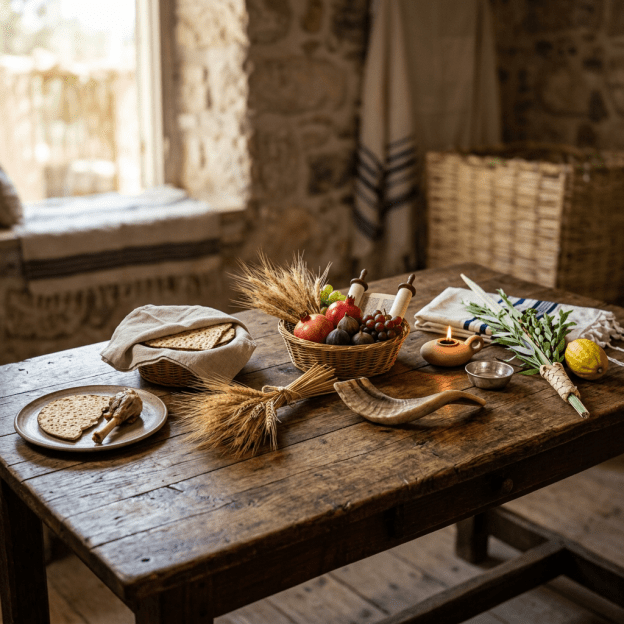
Rustic wooden table with Passover Seder items: matzah, shofar, grapes, pomegranate, candle, olive branch, lemon, and scrolls.

Easter Reflections: From Exodus to Resurrection

(For those of you who read my blog, you will quickly realize that I wrote on the subject of Passover a short while ago. I feel that it might prove helpful if we look a little more closely at the far-reaching ramifications of all seven annual feasts celebrated by the people of the Jewish faith. Why? Because, as you will see, Jesus is the main character in each of them!)

We have just been blessed to once again celebrate Easter, the resurrection of our Lord Jesus Christ. This should be a season of great joy and gladness as we give attention to the most amazing event in all of human history. And yet, we often pass it by without giving thought to what Easter is really all about.

Let me take you back to times and places we read about in the Bible so that we might be able to better understand what we have once again memorialized. To find the story behind what we call Easter, we must go back, way back, to approximately 1500 years before the sacrificial death of Jesus. Think about the story of the exodus of the people of Israel from Egypt, under the leadership of Moses.

The Israelites had spent over 400 years in Egypt. They went there in a time of desperation, as they were experiencing a horrific famine in their homeland. Joseph, one of Jacob’s twelve sons, had through a series of events orchestrated by the sovereign action of God become a powerful leader – second only to Pharaoh himself – in Egypt. It was through the providence of God that Joseph was able to provide for his family, ultimately moving them to Egypt, where they took up residence at the invitation of Pharaoh.

Over the passing of time the Israelites grew in number in such a profound way that they were thought of as a threat to the welfare of Egypt, so the relationship changed from that of welcomed guests to that of slaves. Thus, their need of a deliverer who would lead them to freedom.

Center stage – Moses. God uses this man to lead the people of Israel – by the time numbering approximately 2,500,000 – out of Egypt to the land of promise. It was on the night of their departure from Egypt that God gave Moses instructions to the people of Israel concerning Passover.

When the angel came through the land of Egypt and saw the blood of the lamb, he would “pass over” the household of those protected by the blood!

God revealed that an angel would pass through the land of Egypt, killing the firstborn of every household in that country. However, the people of Israel would be safe from the death angel’s assigned task by sacrificing a lamb and smearing the blood of that lamb on the doorposts of their homes. When the angel came through the land of Egypt and saw the blood of the lamb, he would “pass over” the household of those protected by the blood!

This celebration of Passover became an annual tradition for the people of Israel. They participate in this tradition to remind them of this great deliverance God provided for their ancestors long ago. But Passover is only one of seven annual feasts of Israel. Under the leadership of Moses, God gave instructions for these annual feasts, and in looking carefully at each of them we see an amazing portrayal of the Gospel of Jesus Christ!

God gave instructions for these annual feasts, and in looking carefully at each of them we see an amazing portrayal of the Gospel of Jesus Christ!

Those seven feasts of Israel, in the order in which they were to be celebrated each year, are:

  • Feast of Unleavened Bread
  • Feast of Passover
  • Feast of Firstfruits
  • Feast of Pentecost
  • Feast of Trumpets
  • Day of Atonement
  • Feast of Tabernacles

When we read through the Bible and come to those passages giving the tedious details of these feasts, our tendency might be to give them a cursory glance or just skip them all together. But to do so is a tragic mistake, because it is here that we see, in vivid detail, the story of the Messiah, our Savior, Jesus Christ!

Take a moment to look over the list of feasts and note particularly the order in which they are to be observed. God gave them a picture – a portrait – of His Son. The picture begins in the New Testament with John the Baptist seeing Jesus approaching, and making the announcement, “Behold, the Lamb of God.” From our New Testament perspective – and to be more accurate, from our twenty-first century perspective – we can easily miss the detail of this portrait. But the people who heard John speak these words would have known exactly what John was referring to – the Passover Lamb they had long anticipated.

My next blog will be an overview of each of these seven feasts. When we see Christ in the Old Testament, and realize how meticulously God gave Moses instructions for the annual celebrations, we will see Jesus Christ in all of His glory. It is a story that you don’t want to miss.

Hallelujah – what a Savior!
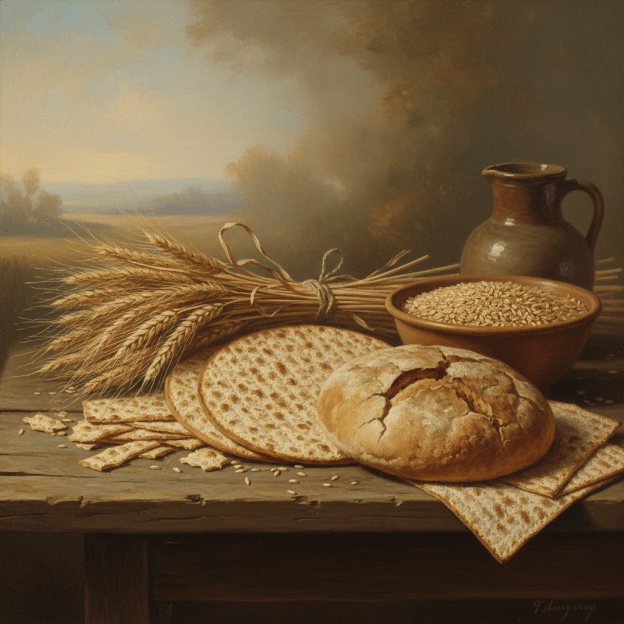
Unleavened bread and barley still life painting

Easter vs Passover: Clarifying Biblical Terms

Where would we be without Easter? Before I address that question, let me take a moment to address the issue of the word itself. Is Easter found in the Bible? Well, yes, and no. The word is found in the King James Version of the Bible. Found in Acts 12:4, the verse reads: “And when he had apprehended him, he put him in prison, and delivered him to four quaternions of soldiers to keep him; intending after Easter to bring him forth to the people.” This is in reference to Peter being arrested, and kept in his cell until after Pascha (Hebrew for Passover). Thus, it is a clear reference to the Jewish feast of Passover rather than to a day referred to as Easter.

Is this really important? I think that we will reach the solid conclusion that it is crucially important when we understand the significance of the word. Easter has no place in the original languages of the Bible. There are varying explanations as to how the word “Easter” came to be in English translations of the Bible, but the one that seems to have the most consensus is that when the King James Version (KJV) was translated in 1611, the word Easter was commonly used in reference to the Passover, and would have had that understanding to those in that era who read that particular translation. However, with the changing of the definition of words through the years, it is now a matter of confusion. Thus, it is far better to understand Acts 12:4 as Passover, not Easter.

Now let’s consider the ramifications of not using the word “Passover”. Passover is one of three Jewish feasts that take place within an eight-day period. It begins on Sunday, and concludes on Sunday. The first Sunday begins the Feast of Unleavened Bread, during which all leaven must be removed from Jewish homes for the duration of those eight days. It then concludes on the following Sunday, which is the Jewish Feast of Firstfruits. Between these two Feasts is the Feast of Passover, which is celebrated on Thursday.

The reason we should be careful to use the right terminology relative to each of these Feasts is because Jesus is the fulfillment of all three. Let’s consider carefully this extremely important part of those Feasts of Israel, and how each is related to Jesus.

To begin with, these are not to be thought of as being types of Christ found in the Old Testament. Think of a type of Christ as being a symbol, or picture, or foreshadowing, of the coming Christ. There are many of these types of Christ found throughout the Old Testament. However, we must be careful that we do not think of Firstfruits, Passover, and Unleavened Bread as being symbols, or types of Christ. Why? Because the New Testament makes it clear that Passover is not a type of Christ, but rather that Christ IS Passover. Firstfruits is not a type of Christ, but Christ IS Firstfruits. Unleavened Bread is not a type of Christ, but Christ is the Unleavened Bread.

Read the following verses carefully:

“And Jesus said to them, ‘I AM the bread of life. He who comes to Me shall never hunger, and he who believes in Me shall never thirst.'” John 6:35

“But now Christ is risen from the dead, and has become the firstfruits of those who have fallen asleep.” 1 Corinthians 15:20

“Therefore purge out the old leaven, that you may be a new lump, since you truly are unleavened. For indeed Christ, our Passover, was sacrificed for us.” 1 Corinthians 5:7

Jesus Christ IS the Bread of life, Firstfruits, and the Passover Lamb. This should make it abundantly clear that those Feasts of Israel are all fulfilled in our Lord, Jesus. We must not allow the world’s practice of changing the meaning of words to adversely affect these three terms that are so profound as we think about the season we refer to as Easter. We must maintain a commitment to the clear teachings of Scripture, especially those that teach us these phenomenal truths about Jesus.

So, what exactly should we call the day we have come to know as Easter? Simple: according to God’s plan as laid out in the Old Testament, we celebrate Unleavened Bread (we normally refer to it as Palm Sunday), Passover (Thursday after Unleavened Bread), and Firstfruits (we call it Easter). To understand the meaning of these terms, and the significance of the Old Testament feasts that were all fulfilled in, by, and through Jesus Christ, will shed so much light and provide so much clarity in why these Christian celebrations are rooted in Old Testament worship.

For over 3500 years orthodox Jews have participated in Communion every time they celebrate Passover

And now for the reason for this blog. Did you realize that for over 3500 years orthodox Jews have participated in Communion every time they celebrate Passover? And secondly, did you also realize that for over 2000 years the church has celebrated a part of Passover every time they have observed the Lord’s Supper?

For over 2000 years the church has celebrated a part of Passover every time they have observed the Lord’s Supper

It was during the observance of Passover that Jesus took a specific piece of unleavened bread, broke it, and said, “This is my body given for you.” Then, He took the third cup of wine served during the meal, and said, “This is my blood, shed for you.” That is astounding! Jesus IS the Passover. He is the ultimate Passover lamb whose life was given for others.

It is remarkable how God actually provided these graphic portraits of His Son approximately 1500 years before His birth. What a mighty God we serve – Amen!

Blessings!