Forty-fifth Anniversary Celebration

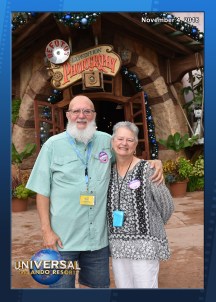
This week, Teresa and I are celebrating our 45th anniversary. The celebration itself was a bit delayed (about five months!) due to time constraints, but we are now able to get away for a few days and enjoy one of our most favorite things: Universal Studios and Disneyworld.

61699_110418_000940968

For the years of our marriage, we have always enjoyed amusement parks. When we lived in Texas, we had season passes every year to Six Flags. Since moving back to Lancaster, SC, in 1998, we have had season passes to Carowinds almost every year. We now live and work at Carowinds! And, every chance we get, we visit the attractions in Florida.

61501_110418_000101854  61705_110418_000161452  61204_110418_000017832

Yes, there are those who think we are a little too old for roller coasters and other such attractions, but it is what we have always enjoyed doing, and will probably continue to do.

Having said that, though, I am also very much aware that we are on mission for our Lord Jesus Christ everywhere we go – even amusement parks. We are striving to be a witness for Him as we make our way through the rides and attractions. Wearing a pin that says “Celebrating Our 45th Anniversary” opens up quite a number of opportunities to share a message of God’s grace. It is amazing the number of people who will congratulate us, and then ask the secret to our long-term relationship. We usually don’t have time to go into a lengthy discussion, but we quickly tell those who ask that Jesus Christ is the secret to our successful marriage.

61703_110418_000033307

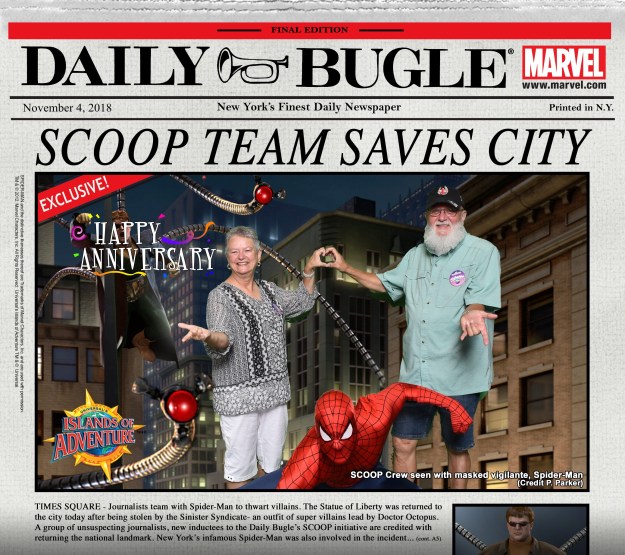
When conversing with Spiderman (and yes, this was the REAL Spidey!) he talked with us for several minutes before the photos were taken. We told him a little bit of our story, so he had us pose with the “heart” symbol to illustrate our love for one another. Even the amazing Spiderman himself was a bit amazed!

And, yes, I must admit that I am a bit amazed at how incredibly easy it is to be a witness for our Lord wherever we happen to be. I also must insert here the fact that it is usually Teresa who engages in conversation due to the fact that I’m not wearing my hearing aids for fear of losing them on some wild ride. But Teresa is doing an unbelievable job in sharing our story, and I nod in agreement with a smile on my face.

One thing that stands out from several of our conversations is the fact that so many are absolutely astounded that we have been married 45 years. I know that there are many who have been married much longer than this, but from our conversations it must certainly be a rarity. People we meet are truly amazed at the longevity of our relationship, and it gives us all the more incentive to share our “secret,” which is really no secret at all. And yet, it seems to be a well-kept secret from so many. Oh, how I wish others could experience His love and grace as we have for these past 45 years.

Today, our plan is to go back to Islands of Adventure and Universal Studios to enjoy more rides and attractions. It is my prayer that as we go we will continue to have opportunities to share of His amazing love and grace. Could I close with a simple word of encouragement for you to do the same? His story is so worth repeating.

Let’s Go About Doing Good

Jesus went about doing good. That sentiment is stated clearly in Scripture, but more than being stated, it was actually seen. His actions spoke volumes above and beyond His words. Everywhere He went He was involved in doing good. He reached out to everyone, everywhere. He showed no favoritism toward one over another. He never stopped by simply giving a word of hope, but actually gave hope to those who would receive it.

Through my sixty-six years of life, I have seen so many lives radically changed because of the intervening, interrupting invasion of Jesus into the midst to horrible circumstances. And, more often than not, this intervention of Jesus was observed through the hands of His servants. In other words, Jesus works through those who identify themselves with Him and follow closely in His footsteps, following His example of sharing hope with the hopeless, and giving help to the helpless.

Yes, I have seen individual Christians as well as loving church families taken advantage of by those who know how to work the system. One church I served as pastor was located on a busy thoroughfare in a rather large metropolitan area. We were visited several times every week by individuals or families asking for a handout. After a while we began to notice that some of those dropping by for this purpose looked familiar, so we started keeping records of names, dates, and any other pertinent information we felt necessary to make wise decisions in giving assistance. It became obvious that there were many who simply worked in rotations, going from one church to another taking advantage of well-meaning ministries resources and compassion.

However, I’ve also seen many who were in genuine need. They desperately needed someone to give them a helping hand. They were not intentionally trying to defraud anyone, but were in a situation that was completely beyond their control. Usually, these were not the ones we see living on the streets, under bridges, sleeping in cardboard boxes or make-shift tents. No, these are the ones who have been hit hard by the unforeseen circumstances of life. They are not where they are by choice, but by the life-altering uncertainties that so often take us completely by surprise.

Years ago there was a catchy little phrase that sort of captured the minds and hearts of many sincere, well-meaning Christians: What Would Jesus Do? Many wore bracelets with the letters “WWJD” engraved or imprinted to serve as a constant reminder that I should pause and ask that question of myself before making a decision or engaging in an activity. I, personally, have paused and asked that question of myself on many occasions.

A while back I had the awesome privilege of seeing the work of Kevin Lilly. He was moved to engage in a ministry to the down and out. This lead to a mobile shower ministry for those living on the streets, and to a “Street Feet” ministry where a group of people would go into “tent villages” and truly minister to those in dire straits. He asked the question, “WWJD?”, and then he went out and did it. Was Kevin ever taken advantage of? Absolutely! Did that deter him from his work? Absolutely not!

We never know the circumstances or life situations that forced an individual or family to decide to live on the streets. Some, again, are there by choice. But the vast majority of them are not.

So, what are we to do? As an individual? As a family? As a church family? How are we to respond? Well, we could just turn a blind eye, a cold shoulder, and a deaf ear to the genuine cries for help. We could justify our actions by making the assumption that they could do better for themselves if they would just give some effort. And, perhaps that is true in some instances. But there are some individuals out there who are genuinely hurting, crying out for help, and the cries are falling on deaf ears, cold hearts, and blind eyes.

My challenge to each of us with this blog is to get back to asking the question: What would Jesus do? Then, seek His guidance in determining how I, we, might be the best representative for Him in the situation. In other words, let’s go about doing good.

What is Your Mission Field?

Do you have an acknowledged, recognized, specific mission field? You might think, “What in the world is he talking about? I’m not a missionary!” Too often, we tend to think of missionaries are those specially called and gifted individuals who go off to some far-away land to share the gospel with those who have not heard. We don’t apply the term ‘missionary’ to self.

That, in my estimation, is one of the major reasons Christianity has taken a back seat to other world religions in our present American culture. We think that being a missionary is someone else’s job, someone else’s task, someone else’s calling. That mentality frees us from a sense of responsibility in the tasks of missions work.

Before I go any further with this blog, it would probably be helpful if I defined exactly what I am referring to by the term missionary. I am using the word in the Biblical sense of simply being on mission for the Lord Jesus Christ. I realize there are those who experience a powerful calling from God to serve in full-time vocational missions work. But the fact of the matter is that the overwhelming majority of us will never experience such a calling as this.

I am not speaking here of that type of missionary. I am speaking, rather, about every believer in Jesus Christ; every individual who has experienced the saving power of God’s grace through the sacrificial death of Christ. Every individual believer is on mission for the glory of our Lord. Yes, we are all missionaries.

Now to the question posed in the title: what is your mission field? You do have one, you know. It is specific to you. It is your God-appointed place of mission work. And this is one thing I can say with absolute certainty: I know exactly where YOUR mission field is! That’s right – you read that last sentence correctly. This is one answer I can give with no fear that I will steer you wrong. I know what you’re thinking: That sure is arrogant for him to say! But please, hear me out.

It may be a foreign thought to some, because it is not a clearly taught principle you will find in the teachings of contemporary American Christianity. We are taught, more indirectly than directly, that our Christian expression is confined to certain hours of certain days of the week. We express our Christianity when we are gathered with other Christians. This is our common belief, and our common experience.

But this is not the Biblical portrait of personal missionary activity. The clearly taught concept that is seen in Scripture is that – here it is – your mission field is wherever you are, with whomever you are, everywhere you are, every moment of every day. In other words, we are missionaries 24/7/365. There is no time off. We are to be missionally minded and missionally intentional constantly.

This may seem to be an overly simplistic concept, and you may be wondering why I would write a blog on this topic. Let me explain. There seems to be a rather dramatic line of demarcation we make in our understanding of the demands of our Christian faith. We are Christian, first and foremost. Our relationship with Jesus Christ should be the number one priority in life for each of us. We are redeemed by the precious blood He shed on the cross, paying the penalty of our sin, and suffering the punishment we so rightly deserve. We are, as the Apostle Paul stated, Christ’s possession. We have been bought with a price.

I represent Him everywhere I go. So, my mission field, your mission field, is wherever we are at any given moment.

Now, let me draw this to a close by making some personal observations. For some reason, so many professing Christians seem to have adopted the mentality that what I am when gathered with other believers, and what I am when gathered with non-believers, are two entirely different and unrelated matters. I can just blend in with whomever, wherever, and whatever.

But Jesus taught that His disciples are to be salt and light. We are to let others see our good works and glorify our Father in heaven. We are to be His representatives as we fulfill our mission of showing Him to the world and sharing Him with the world.

That means that what you do on your job, in your classroom, in your community, in the check-out line at Wal Mart, on social media, is a representation of your relationship with Jesus Christ. You are on mission, and you are a witness. You may be a good witness, or a very bad witness, but you ARE a witness.

In the recent past, Christians have had amazing opportunities to display His love, grace, compassion, and message in the midst of an explosive political quagmire. But, we have stooped to bashing, lashing out, with no sense of civility, no sense of respect. Can’t we disagree with others civilly? Can’t we respect others even when we disagree vehemently? Do we have to become bombastic, even barbaric, in the way we show our disagreement and disapproval?

Please remember that we are on mission. Our first priority is to be representatives of our Lord and Savior. So, let’s get out there and represent Him well!

What Are You Banking On?

Could I be so bold as to ask you a very personal question? What is it that you are banking on? What is it that you have placed your hopes in for your future? By future, I am referring to your immediate future, your extended future, and ultimately, and most importantly, your eternal future.

First, let’s think for a moment about your immediate future. Maybe you are one of those who is banking on your educational accomplishments to open doors for you to embark on your dream career. Perhaps you have gone through the grind of all those classes which were required for you to achieve your degree of choice. And now, having completed the educational journey, you are ready to set sail on an exciting career that you are banking on to provide a lucrative means of income as well as a life-long adventure in your field of choice.

Or, perhaps you are banking on a successful stint as a major league sports star. Perhaps you have excelled in your particular sport through high school and college, and you are now awaiting that call from that sports franchise which will secure your future.

Another possibility is that you are banking on financial investments to secure your future. Perhaps you are a careful observer of the movements of the stock market, or you have invested in other forms of what appear to be promising financial opportunities that could secure your future for years, perhaps even decades, into the future.

Or,  maybe you are banking on a relationship with your significant other to make your future bright and exhilarating. Your love for that individual will be all you need to guarantee a future that is filled with nothing but love, laughter, and lots of fun.

These four examples provide us with a brief glimpse at what we might have placed our hopes on for the future, and we are banking everything on what they will provide.

Now, let’s think for a moment about the extended future. And again, we can focus on the four examples we have mentioned above. Educational accomplishments, athletic abilities, relational engagements, financial investments are entered into with the hope that they will last a lifetime. All we can envision is the brightest of futures as we embark on the many different paths of life. And as we embark on our path of choice, we bank on it being a most fulfilling, rewarding, life-long journey.

Oftentimes the things we are banking on produce amazing rewards. That promising, even though highly risky, financial investment could provide much more than expected. Those long, difficult years of grueling educational exploits might provide that exciting career that brings you years of fulfillment. That relationship could provide years and years of happiness, even though it is riddled with challenges you never dreamed of encountering.

However, those things we are banking on sometimes leave us empty, broken, filled with remorse and regret. Careers lose their original luster. Educational achievements never produce the expected results. Athletic careers are ended instantly with a career ending injury. Those financial investments crash and burn, leaving us not only broken, but actually broke.

Someone said that we must never fall prey to the tendency of putting all of our eggs into one basket. If our hopes of a bright, exciting, amazingly productive future is focused on one thing, then if that one thing fails we feel as if life is over, no longer worth living. However, if we have a combination of several foci, then if one should happen to fail, we are not left with nothing, but we still have other investments which can now fill in the gap left by the one that has failed.

Now, having said all that about the immediate future and the extended future, let’s think for a moment about the eternal future. Making plans for the eternal future, and then banking on that plan, is much more important than the investments of education, athletics, finances, and relationships. We can make those plans, and even if they fail to provide us with the expected returns and rewards, we can still learn from the mistakes made and move on.

But, if we make the wrong plan for our eternal future, then there is no second chance. So please, allow me just a few more minutes of your time to talk about the most important decision you will ever make.

The general consensus of the present day is that there are many roads that lead into heaven. We might hear some say that it doesn’t really matter what you believe, as long as you are sincere in your belief. You may be banking on one of the many paths which are prevalent today. You may be banking on the fact that you are a very good person, one who is loving, caring and benevolent. You are banking on your belief that as long as your good outweighs your bad then it will gain you entrance into heaven.

Or, maybe you are banking on your fervent religious activity to get you into heaven. You are totally committed to your church, or synagogue, or mosque, or temple. You are actively involved in the ministry activities. You believe firmly in the teachings of your faith.

Or, perhaps you are one of those who simply refuses to believe that there is anything beyond this life. You live, you die, and that’s the end.

Just what are you banking on? Well, this decision is like no other decision you will ever make. You can go back and earn a different degree and pursue a different career path. You can make different financial investments and secure a financial future that will provide a level of comfort and fulfillment. You can pick up the pieces of a ruined athletic career by going in a new direction. You can even move on after a broken relationship.

But, if you miss out on the eternal decision that will result in your entrance into heaven, all hope is lost – forever.

I will this blog by stating categorically that there is one, and only one, road that leads to heaven; the only thing that you can bank on with absolute certainly. Jesus stated emphatically, “I am the way, the truth and the life. No one can come to the Father except through me.” You cannot go to heaven by religious activity, by being a perfect citizen, by making sure the good outweighs the bad, or any other means. Jesus is the only way.

And the great thing about it is, when you put all of your eggs in the Jesus basket, you are safe and eternally secure. You can bank on it!

So, life-altering decisions can be draining, depressing and discouraging. But, you can pick up the pieces and keep going. But the eternal decision has to be right. It is the only thing that is absolutely trustworthy. Make sure you are banking on Jesus, and He will never let you down.

 

Why?

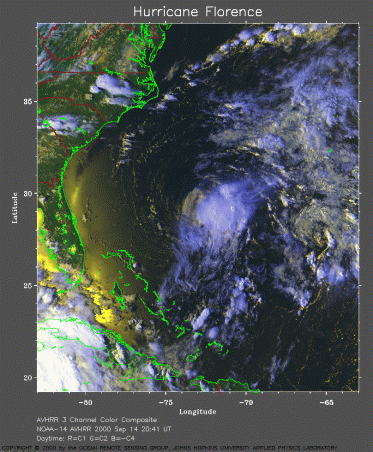
Last week, I wrote about the impending storm, Hurricane Florence, and then tried to make some practical applications on how to deal with the storms of life. Today, I want to revisit the subject of Florence, but this week I want to face the subject head-on. Oftentimes, as I did last week, we skirt around the real issue, not wanting to deal with the difficulties of putting a destructive storm into the purposes of a good and loving God.

We so often hear the testimony of those who have been spared any personal damage from the storm, saying, “God is so good! We prayed for His protection and He protected us from the storm.” What exactly are we to understand from such a word of testimony? Are we to understand that God loves the one spared more than He loves the one who prayed the same prayer, but who suffered great loss? How do we deal with such seeming contradictions in God’s prayer-answering activities?

As of this writing (Sunday morning, September 16) it is reported that eleven people have died as a result of Florence. I didn’t know any of these individuals, but I imagine that at least some of them, if not all of them, had prayed for protection. Was God upset with them? Was He punishing them for some reason known only to God? Was He not good to them?

I was awakened early this morning by the howling winds and the heavy rains of Florence. I looked out the windows; I opened the door and peered into the darkness. Admittedly, I was a little shaken by the sounds, thinking that the large tree just outside could topple over at any time. Thankfully it did not, and hopefully and prayerfully it will not as the winds continue to blow, and the rains continue to fall. But does that mean God’s favor is on me and not on those whose homes have been destroyed by falling trees? Of course not!

But the fact of the matter is, when we say, “Isn’t God good? He didn’t allow that tree to fall on my house,” we are insinuating that His goodness depends on the good things He does. So, back to the subject at hand. Why does God’s protective arm keep some from danger and destruction, while He seemingly withholds His protection from others? Others, I might add, who have prayed just are urgently and fervently as those who are spared.

I have studied this subject diligently. I have read so many different views from quite a number of different authors. I have given consideration to those who speak from a more conservative perspective, and those who come from a more liberal point of view. I have noticed a great discrepancy between those two extremes. Liberals approach the subject from a non-theological, scientific perspective, while conservatives approach it from a theological/scientific perspective. Liberals seemingly can’t figure out any way to put God into their understanding of the workings of the universe, so they give a totally humanistic explanation, while conservatives strive to understand all the eventualities of life from a God-centered perspective.

Thus, from the liberal point of view, there is no rhyme or reason to storms such as Florence. It is just a natural phenomenon, which is being exacerbated by global warming. Whereas from the conservative perspective, everything should be filtered through the grid of a theological, God-centered perspective.

Now, admittedly, it is much easier to explain storms such as Florence from the liberal slant, because it is just a natural event which can be explained using scientific equations. But from the conservative perspective it is much more difficult because we are once again left trying to ‘defend’ God’s reputation.

Again, I have read countless commentaries, encyclopedia entries, and scholarly articles on this subject. Some have given a rather simplistic response, while others have tried to dive more deeply into the mysteries of God’s activity in such catastrophic events. None claim to have a definitive answer to this dilemma. I am not suggesting that I have it all figured out, but I will share what I have personally come to believe, and the answer which gives me the most peace of mind.

In one way, my response is quite simplistic. The Bible is clear in teaching that God’s ways and thoughts are much higher than ours. He works in ways that are far above and beyond our ability to fully understand. Therefore, we will never be able to fully fathom the intricate workings of the universe. We simply marvel at the majesty and grandeur of creation.

But, we also understand from the Bible that the earth is under the just and justifiable wrath of God due to man’s rebellion against the perfect plan and purpose of God. All the negatives of life we encounter are a result of this judgment of  God against His creation. Again, God was perfectly just in issuing this curse as He had promised man that rebellion against God  would result in this curse.

And finally, all of humanity is under this curse. Righteous and unrighteous are equally affected. As the Bible states, the rain falls on the just and the unjust. No favoritism shown here. When the storms of life come, Christian and non-Christian are equally affected. We all suffer the effects of the storm.

So now to the ‘why?’ Why doesn’t God give special attention and protection to His children? We have accepted His grace in salvation. We have been born into His family. We have been adopted as sons and daughters of God most high. Shouldn’t we be able to expect more from Him? From our human perspective this might make perfectly good sense. After all, if my child and his friend are both in danger of drowning, which will I try to rescue first? Would I not give preference to my child, and then go to the aid of his friend? Shouldn’t God be the same way? Shouldn’t He come to the aid of His children first?

From our faulty, fallen human perspective the answer is a resounding YES! However, God doesn’t work the way we work. He does things that are absurd to us, but that are perfectly sound and reasonable from His point of view.

The human family is under the just wrath of holy God. Until Jesus comes to end history as we know it, we will continue to suffer. Just and unjust alike. No favoritism. God does things to accomplish His plans, not ours. We are here to bring glory to Him. If we are allowed by His grace to suffer, then let us suffer for His glory. Let us show the world that His grace is sufficient to keep us from the storm, to see us safely through the storm, or to allow us to suffer in the storm. It is all for His glory.

And, let us remember, our glory is still yet before us. We will have the privilege of enjoying the eternal blessings of heaven, a glory that is not to be compared with the sufferings of this life. So, let’s praise God for His protection in the storm, but let’s not present the idea that the protection of God is to be equated with the goodness of God. He is good to those who suffer, and to those protected from suffering.

God is good, all the time!

Storm!

Florence

Those of us who live in the southeastern part of the United States are watching with keen interest the path of Florence, a massive storm which has its bulls-eye zeroed in on the coast. It is not certain as of this writing exactly where it will make land-fall, but unless things change drastically within the next few days it will hit somewhere within the cone of uncertainty which extends from northern Florida to northern Virginia.

Life is filled with storms: hurricanes, tornados, floods, all ranging in intensity and duration. Some pass by with little concern while others cause even the most stout-hearted among us to cringe in fear and worry. Sometimes the fear and worry are warranted as those storms ravage the land, leaving a path of destruction in their wake. At other times the storms pass with just a whisper, and all the fear proved to be unsubstantiated.

As Florence approaches, we are hearing warnings, telling us to make preparations. We are encouraged to download our state’s hurricane preparation guide, which contains crucial information in how to make preparations for this, or any future, impending storm. We are to make sure we have all the necessities – bottled water, flashlights with fresh batteries, generators, enough food in the pantry to last several days, perhaps even a couple of weeks. We are encouraged to prepare for the worst while hoping for the best.

This is all good advice, to be sure. Life is filled with uncertainties and storms. Not necessarily storms of nature, but storms of life. Sometimes these storms can be seen coming from a distance, and we have time to prepare. Other times, they come like an unexpected tornado in the middle of the night, with no forewarning whatsoever. We are all of a sudden awakened by the sound of the howling wind, the hail beating on the window panes, and the heart-wrenching explosions of thunder.

Regardless of which form the storm takes, they still have the ability to render us helpless for a period of time. Some, like hurricane Katrina which struck the gulf region of the United States in 2005, are so devastating that even years after the storm the damage is still being dealt with. Others come and go leaving very little damage, and can be overcome easily in a matter of days, or perhaps a few weeks.

This is the reality of life. We all face storms of different magnitude and intensity as we travel through the years. Some are major set-backs which leave us reeling in the aftermath, wondering if we can survive, and if we do, how long it will take for the wounds to heal. Others are minor storms which come and go leaving little evidence that they ever even happened.

So, what can we do to be ready for the storm? Just as we are being warned right now of the dangers of Florence, and what preparations we need to make to be ready, what preparations can we make to prepare us for the storms of life?

I will strive to answer that by sharing my personal commitment to help engaged couples prepare for the uncertainties of life as they prepare for marriage. In pre-marital counseling, I talk about quite a number of different issues, but for the sake of this blog I will focus on just a few.

First, the couple needs to know that life does not always go the way we plan. When asking for them to share with me expectations for the future, I suggest that they think about where they want to be one year into their marriage, then five years, and then ten years. I ask them to tell me about educational goals, career goals, personal goals, family goals. Then, after listening to their responses, I begin the ‘what if’ questions. I want them to realize that the best thought-out plans are sometimes unrealized. Life happens. Things change. Some of those life happenings can be devastating.

I don’t share these things to try to persuade them that marriage is not worth the risk, but to hopefully get them to understand that marriage is full of risks. Storms will come. If we have not thought through some of the ‘what ifs’ then we can easily be destroyed. We can start playing the blame game, accusing our spouse of causing all the problems. “If you would…” “If you could…” “If you hadn’t…” We can turn a blind eye to our part of the problem.

Second, the couple needs to know that even though life happens, and plans have to be changed, it does not mean that the relationship is damaged beyond repair. This is a crucial time for growth and progress. It is not a time to throw in the towel and walk away, but a time to reevaluate, to talk together and discuss the situation. Look for the root cause of the storm, not just surface issues. Granted, this is hard work. We want to find the surface issue, and put a band-aid on it, while not really dealing with what is underneath. This could actually be a bit painful, but it is well worth it in the end.

Think of it in terms of surgery. You may find a spot on your skin, and think nothing of it. But, a friend of yours, who happens to be a trained physician, looks at it and is concerned about what lies underneath that spot. After going to a specialist, you are told that there is a cancerous growth underneath that spot, not visible to the eye. If left alone, it will eventually cause excruciating pain, and eventual death. But, all you see is a painless little spot. Surgery, you are told, will get rid of the problem and you will be cancer free. The surgery will be extensive, and the recuperation will be very painful and discomforting, but it will be well worth it in the end.

So it is with storms in life. Sometimes they will be very painful to deal with, but in the end it will be worth it to go through the process of ‘surgery’ and healing.

And third, and most important, is the fact that God is the ultimate answer to all the problems in life. He is the only One who can enable us to clean up after the storm. He can put all the pieces back together. He can give us peace in the midst of the storm, and then give us victory after the storm. But, we have to be willing to allow Him to do this. Sometimes the storm causes us to take our eyes off of Him. We allow the storm to become the focus, and we lose sight of the fact that God sits enthroned above the storm, unaffected by the storm, able to control the storm, and ready to give victory after the storm.

So, the best preparation for the impending storm is to know that it is coming, and that we are safe in the arms of the only One who can master the storm, and even bring a brighter day after the storm passes than we ever experienced before the storm came. So, whatever your storm happens to be today, or whatever storm you will face in the future, don’t allow the storm to cause you to lose sight of Him. Keep your eyes focused above the storm, and allow Him to show you the path through the storm.

What Could Be?

Last week’s blog was titled, “What Might Have Been?” Just by way of reminder, the gist of that blog was that as we look back over our lives we sometimes wonder what our lives might look like if we had made different choices. I concluded that particular blog by stating we would delve a little more deeply into this matter by looking at how to deal with those times in which we know that we made a bad decision, and we are now experiencing the results of that decision.

Let’s begin by stating the obvious: Life is filled with decisions. We make decisions by the day, multiple times during the course of a single day. Some of those decisions are relatively innocuous, like what we eat for breakfast, what outfit we wear, how we will spend our leisure time, etc. We make those decisions without giving them much thought, and without worrying if we made the right choice.

However, other decisions are not so simplistic. There are those times in life in which we are faced with life-altering decisions; decisions that will have long-term ramifications, oftentimes changing the entire course of life.

Admittedly, in our early years, most decisions are made for us. As children, our parents choose what meal will be on the table, what clothes we’ll wear on any given day, how we will spend our leisure time, etc. But then, as we grow older, those decisions will gradually be given over to us. We then begin to learn how to make decisions, weighing out the different options that are available to us with each choice we make.

We eventually get to the point when the choices in life are ours for the making. What career path will I follow? Where will I go to college? Or, is college even a viable option for me? Do I want to attend a large university, or a small community college? Or, do I think a two-year degree from a technical institute will serve me best? Who will I marry? Where will we live?

Well, that sampling is enough to show that we are faced with a plethora of choices covering a wide variety of options. Then, as we work our way through the decision-making process for each choice, we must ultimately decide which would be best.

Now, to the point.  We may look back on our life at some critical moment of self-evaluation and realize that we really did make the wrong choice. It might be the choice of a career path, a degree program, the college of choice, or the choice not to go to college, the choice to marry this person rather than that person, the choice to live in one city as opposed to another, etc. etc. We might give serious thought to the choices we have made, and realize that we truly did make, not only a poor choice, but absolutely the wrong choice.

So now we find ourselves at a crucial intersection of life. There are several options available to us.

First, we can choose to make the best of a bad decision. For example, I have seen individuals who feel early in life that a certain career path is right for them. So, they invest years of preparatory work to enter into this particular choice of a life vocation. However, after meeting all the prerequisites for the job, and even having worked on that job for a period of time, they come to realize that this is not a satisfying choice. They find it a great drudgery to go to work. They hate their job. But, they have spent years in preparation, and now have years of experience. Are they to just throw it all away? Walk away? Go in a different direction? Start over?

For some, it may be that they chose a certain career path because that is what one of their parents did. We see it happen all the time: a young boy decides to be a fireman because his father is a fireman; a young girl decides to be a nurse because her mother is a nurse. They see the joy these career choices have brought to their parent, and think it will do the same for them. So, they set their course, and find themselves in a career that isn’t bringing them the same fulfillment as it did for their parent. The reason is very simple: They have invested their lives in something they are not geared to do. In cases such as this, there is nothing wrong with moving in a different direction.

However, there is another option. We can choose to stay. We can choose to make the best of what we have. We can assess the situation, giving careful consideration to the many factors that led us to make this decision. We may discover that our present state of dissatisfaction with our current status is not because we made a bad decision, but because of present circumstances. We may find ourselves working with individuals who are extremely difficult. Our present sense of dissatisfaction has nothing to do with the job itself, but more to do with other factors. As a matter of fact, when we stop to think about it seriously, we come to realize that we are still very satisfied with the career path, but perhaps a change of positions or locations in the same field would resolve the issue.

But then, what about those instances in which we realize that we did make the wrong choice. There is really no question about it. I blew it! In those cases, perhaps it is best to find what we are best suited for, and begin the process to move in a different direction.

I realize that I have rambled on quite a bit, and I apologize. However, what I do hope that each of will understand is that bad decisions are not life-ending. What we need to do is the learn from the poor decisions of the past, and allow what we have learned to help guide us in making future decisions.

Let me sum it up with this statement: Failure is not fatal, nor is it final. We can start over. We can move beyond the bad decisions of the past, and enjoy a bright future. The best way to do that is to sincerely seek the guidance of God by turning to His Word, and to individual’s who have perhaps made poor decisions of their own, and have lived to tell their story.

Entrust your future to God, regardless of your past. He will gladly show you the way!

What Might Have Been

John Greenleaf Whittier is quoted to have said, “Of all sad words of tongue or pen, the saddest are these, ‘It might have been.'” Can you relate? As you look back over your life to this point, do you have to acknowledge a time of regret because you know deep down inside that things could have been so different, so much better (or at least you THINK things could have been different or better)? I imagine that each of us who have lived very long could identify certain moments in which we might think this about self.

But would you allow me a few minutes of your time to delve into this matter? First, let me encourage you to think for a moment about that time in your life. In your mind, how do you think things could have been different if that event never occurred, or if you had responded to it differently?

Let’s think about the Apostle Paul as an example. He was a man who suffered terribly. He offers a list of some of his sufferings in verses 22-33 of the eleventh chapter of Second Corinthians. Would you allow me to engage in speculation for just a moment? We might read that passage and think that Paul could have accomplished so much more for the glory of the Lord had he not experienced those setbacks. As a matter of fact, in the very next chapter Paul tells about an episode in which he prayed three times that God would remove some unidentified problem he faced. God chose to allow Paul to suffer that problem, telling him that God’s grace was sufficient for Paul, and He would reveal His strength through Paul’s weakness.

As we go through life we face many different situations. These situations and circumstances can present us with times of extreme pleasure, or excruciating pain. We might feel backed into a corner, forced to make a decision. As we consider the decision, we might identify several different options available to us. We then choose, and go off in a certain direction. Later, we might think back and ask ourselves, “It might have been…. better, different, more profitable, less painful…” The list of possibilities is veritably endless.

However, in all honesty, we really don’t know, do we? We don’t know if things would have been better; they may have turned out far worse. We don’t know if a different route would have produced more profit; it may have cost us everything. All we can do is speculate. But speculation at this point is futile, because there is no way of really knowing how things would have turned out had we chosen a different path.

I would like to close this blog with a Biblical admonition, and then with a few pointers that I would suggest as we go through times of life-changing decisions. James gives us some very helpful instruction concerning this matter. It is found in James 13-16: “Come now, you who say, ‘Today or tomorrow we will go to such and such a city, spend a year there, buy and sell, and make a profit’: whereas you do not know what will happen tomorrow. For what is your life? It is even a vapor that appears for a little time and then vanishes away. Instead you ought to say, ‘If the Lord wills, we shall live and do this or that.’ But now you boast in your arrogance. All such boasting is evil.”

Of course, what we have talked about in this blog is the propensity we have to second guess a decision we have made, and think that things might have turned out differently if… What James is speaking of is making plans for future endeavors. But if we bring these two thoughts together, we can see how to make decisions and then never have to worry about what might have been.

In essence it is simply this: make prayerful decisions, not presumptuous decisions. Don’t make a decision based upon what you presume will happen, because, again, that is nothing but sheer speculation. However, if we take time to pray about the decision, seeking God’s guidance, and then make a decision based on the direction He gives, then we can move into the future with confidence that what we are doing is right. Now, does that guarantee the decision will result in prosperity, plenty, and pain-free living? Absolutely not! The Apostle Paul lived his life as best he could in following the Lord’s will, and yet he suffered terribly. But his suffering resulted in God’s glory.

As believers, that is our ultimate purpose in life: to glorify God in all we do. If we enjoy a life of plenty, glorify God. If we live a life of pain, glorify God. In all things, glorify God. Don’t live life looking over your shoulder into the past thinking about what might have been. Live this moment, and every moment, in the conscious reality of His presence, and trust that He will guide you in every decision you make. He will never, ever, steer you in the wrong direction.

But I know, you are wondering about those times in which you know you made a wrong decision. God gave clear direction, and you chose to go in exactly the opposite direction. What then? That will be the subject of my next blog, so check back for my response to that self-imposed dilemma.

The Simple Pleasures of Life

Pond.JPGThis morning as I sit in silence, looking out the window into the dawning of a new day, I am once again reminded about the simple pleasures of life. You know the ones to which I refer: watching night disappear as the sun’s light pushes the darkness away; watching the tranquil water of the pond right outside my window begin broken by the fish swimming just under the surface; listening to the sounds of the morning as they break through the quietness of this serene scene; listening to God speak as I once again turn attention to His Word, listening for that still, small voice that speaks so loudly and clearly deep within my mind and spirit.

And as I give thought to these simple pleasures, I am quickly reminded of the fact that I do this far too seldom. There are too many days in which I don’t take time to enjoy these simple pleasures. As the popular saying goes, “Life gets in the way.” Would you be willing to admit that this is true of you? Would you be willing to say, in honesty and sincerity, that far too many times life has gotten in the way of your spending time with the Lord?

Please understand that I know exactly how you feel. As I sit here quietly in the stillness of this morning, making conscious effort to not allow that to happen today, I am reminded, sadly and painfully, of the many times I have allowed it to happen. The countless times I have let life get in the way. The multitudes of mornings I have awakened with my mind bombarded with the demands of the day. So many demands, in fact, that I didn’t even know how to begin the day. What is the number one priority? What demands my attention first? How can I be the most productive today in tackling my ‘to do’ list? Then, in a state of utter frustration, I frantically try to make the most of the hours in this day. But, alas, there have been far too many days in which I get to the end of the day and realize that I accomplished very, very little. Not only did I not complete the tasks on the list, but the list has now grown longer. So, sitting in despair and discouragement, I begin trying to devise a plan for tomorrow, while hoping and praying once again that life will not get in the way tomorrow as it did today.

Can you identify? Do you find yourself shaking your head in agreement that the preceding paragraph describes you more often than not? If so, would you allow me to make a suggestion that could very possibly help? I know it has helped me, and I feel quite confident that it will be of great help for you, as well.

Please know that what I am about to share was learned the hard way by this writer. There was a time in my life – a very long time, actually – in which I allowed life to not just get in the way, but to stay in the way. It was a constant for me. The demands of life, and the desire to do the demands of life in short order, were the driving force behind all I tried to do. The specific time in my life to which I refer was the decade of the 1990’s. At that time I had the privilege to serve as pastor of Lochwood Baptist Church in Dallas, Texas, while at the same time striving to fulfill the requirements to earn a doctorate in theology. It was an extremely busy time. I was busy, and enjoying every second of the busy-ness.

But, I did not realize the negative ramifications of my over-zealous behavior. Then, it happened. My church family, for pastor appreciation month, sent me and my wife to Colorado Springs, Colorado, for a relaxing week at Son-scape Recreation Ministries. I thought it was going to be a fun-filled week enjoying the beauty of the rocky mountains. Well, we did have some time to enjoy the beauty of the rockies, but we soon learned that we were not there for the enjoyment. We were there to undergo eight days of intense psycho-analysis. I am going to just cut through all the details, and move directly to the last day of our eight-day stay. I was told, after hours of individual and group meetings with the staff, that I was a perfectionistic workaholic. I laughed. Teresa cried. I thought they were joking; Teresa was thankful someone finally had the nerve to tell me the truth. I had let life get in the way, and take complete control.

Now please understand that all through this time I was going through the motions of having a quiet time with God every day – religiously. But, admittedly, it had become mechanical. I was just going through the motions. You could ask me fifteen minutes after my morning Bible reading what I had just read, and I would be clueless. It was just a chore that I had to do. But in all honesty, it was a waste of my time. I was not listening for that voice from above, I was just trying to move to the next task on my list.

On that day, I came face to face with the reality of who I had become. Life had robbed me of living. And because of someone being willing to tell me the truth about me, I was able to begin making changes that would allow me to live life, rather than being drug through life.

So, what are the lessons? They are really quite simple. Slow down! As the old cliché says, take time to smell the roses along the way. Enjoy the simple pleasures of life. Learn the practice of taking things a little easier than you have in the past. Begin your day with the Lord. Listen to Him speak to you through the pages of His Word, and then respond to Him in praise and gratitude. You will then be prepared in your spirit to continue to share with Him your requests and burdens. Then, be in control. Don’t let life’s daily demands control your daily activities, but rather you take control of them. Learn to prioritize. Develop the skill of being able to distinguish between what is absolutely necessary, and what has very little importance in the broad scope of things. Develop the habit of delegation. If it is not something that must be done by YOU, then let someone else do it.

It all sounds so simple, and yet it isn’t. It will take time and effort for you to develop the simple habits I have suggested. But it will be well worth it in the end. You will eventually find yourself looking back over your day with a sense of accomplishment. You will see that list of priorities being completed. You will find that you are free to stop and smell the roses, enjoying the simple pleasures of life.

So, now, have a great day! I’m going fishing!

DSC_0011 (2)


Where Are We Going?

My family moved to Dallas, Texas, in 1987. I remember vividly as if it were just yesterday our first trip to that city. I purchased an atlas with maps of every state in the nation. I pored over the state maps of those states we would travel through on our journey. I was going a way that I had never been before, and I needed all the assistance I could get to make sure we did not get lost along the way. After choosing what I thought would be the best route, I highlighted the entire path we would follow. My wife, my trustworthy navigator, then gave instructions as we made our way along that almost 1100 mile journey.

When we decided to move to Dallas, we used that trusty atlas for the next several trips back and forth to visit family in South Carolina. However, it became obvious that I no longer needed to depend so much on my wife’s navigation. The route became more familiar. The different turns along the way became habit. Eventually I found that I no longer needed the atlas or the navigation. I knew the route so well that I could go the entire way with no assistance at all. Finally, I knew where I was going.

On September 13, 1977, I began a new journey. I set off on a path I had never traveled before. It was vastly different from the path I had been traveling. Everything was new. The path called for new directions – a new atlas, so to speak. The atlas was readily available. It contained detailed information on how to make it safely to my destination. It was written in such intricate detail that it was amazingly easy to follow. However, there were possibilities of deviating from the clearly established path, so it also contained warning signs along the way to warn of dangers that might be lurking ahead. The instructions were clear, and as long as I remained on the designated path I found that it was exceedingly safe and secure.

I have now been traveling this path for quite a while. I have studied the atlas diligently through the years since I first discovered it. It has provided me with invaluable information that has safeguarded me against many of the pitfalls that could have ensnared me through the journey. The path has sometimes seemed dark and foreboding, and on more than a few occasions I felt as if I had lost my way. It was on those occasions that I was driven back to the atlas to once again get my bearings, and once again get back on the right path.

The journey to which I refer is the journey of being a follower of Jesus Christ. The atlas to which I refer is the Word of God, the Bible. The path to which I refer is the narrow way spoken of by Jesus Himself. And the directions to which I refer are given to anyone who will take time to seek guidance and direction from Him.

Jesus said that life consists of two roads: one broad, and filled with countless throngs of travelers; the other narrow, and traversed by very few. The broad way is the way of the world. It can be described in many ways, but the descriptive terms I will use are from the atlas itself. The philosophy of the broad way is “eat, drink and be merry.” It has been worded in so many different ways in recent years: “get all the gusto out of life,” “if you’re not with the one you love, love the one you’re with,” and so many others. It is filled with frivolity and pleasure-seeking individuals who give little to no thought of eternity.

But the narrow path is the one chosen by those who take the atlas seriously. It is the path that is clearly marked in God’s Word. Jesus said that He was “the way, the truth and the life.” He further stated that the only way to the Father was through Him. In other words, Jesus is the one and only path that will result in ultimate fulfillment for those who choose to follow the narrow way.

After all these years since 1977, I still strive to follow the path I discovered in His atlas. I read it constantly, study it diligently, follow it obediently. And on those occasions in which I veer off course, I am quickly reminded by the presence and person of the Holy Spirit Himself that I need to get back on the narrow path.

The broad path can oftentimes be so alluring, so appealing, and if not for the constant testimony of the atlas that I have committed to memory through these many years I could easily be drawn to it. That is the reason I must consistently and constantly give my attention to the directives of the one and only atlas that shows the clear path to abundant life, and gives the promise of eternal life to those who follow.

So, where are you going?