Category Archives: Uncategorized

A Public Confession of Faith

This week we have celebrated once again that monumental day that changed the church, and the world, forever. While most eyes were focused on costumes and candy, perhaps we forgot that pivotal day in history commemorating Martin Luther’s act of defiance when he nailed his 95 theses on the door of a church in Wittenburg, Germany. Those 95 statements, calling for reform in the Catholic church, reverberated from nation to nation as others began calling for reformation. This movement, which has become known as the beginning of the Protestant Reformation, sent ripples, if not tsunami waves, crashing on the shores of nations and continents.

While thinking about this, my mind focused on Martin Luther’s trial, as he was brought before the Diet (assembly) of the Holy Roman Emperor held at Worms, Germany, in 1521. It was a watershed moment in his life, as he was commanded to recant his 95 theses, and submit to the teachings of the Catholic church, which he refused to do. His final statement to the assembly was: “Here I stand, I cannot do otherwise. God help me. Amen”

Here I stand, I cannot do otherwise. God help me. Amen.

Luther knew the costs of what he was doing. He knew the assembly had the power of life or death over one who had refused to adhere to the teachings of the church. And yet, his concluding remarks to the assembly showed that his commitments were first and foremost to God, and to His Word. This event sparked what has come to be known as the Protestant Reformation, and it is still producing powerful results in those churches and denominations that adhere to the Biblical teachings that came about as a result of this moment in history.

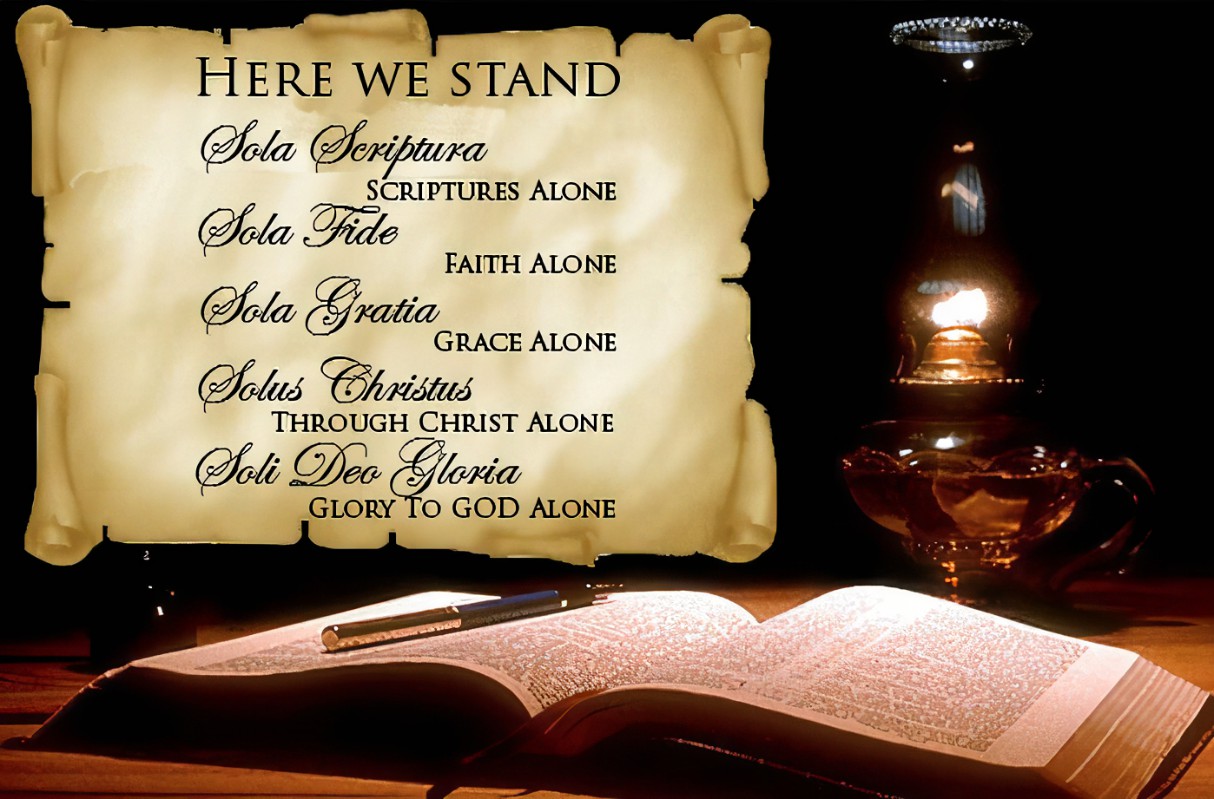
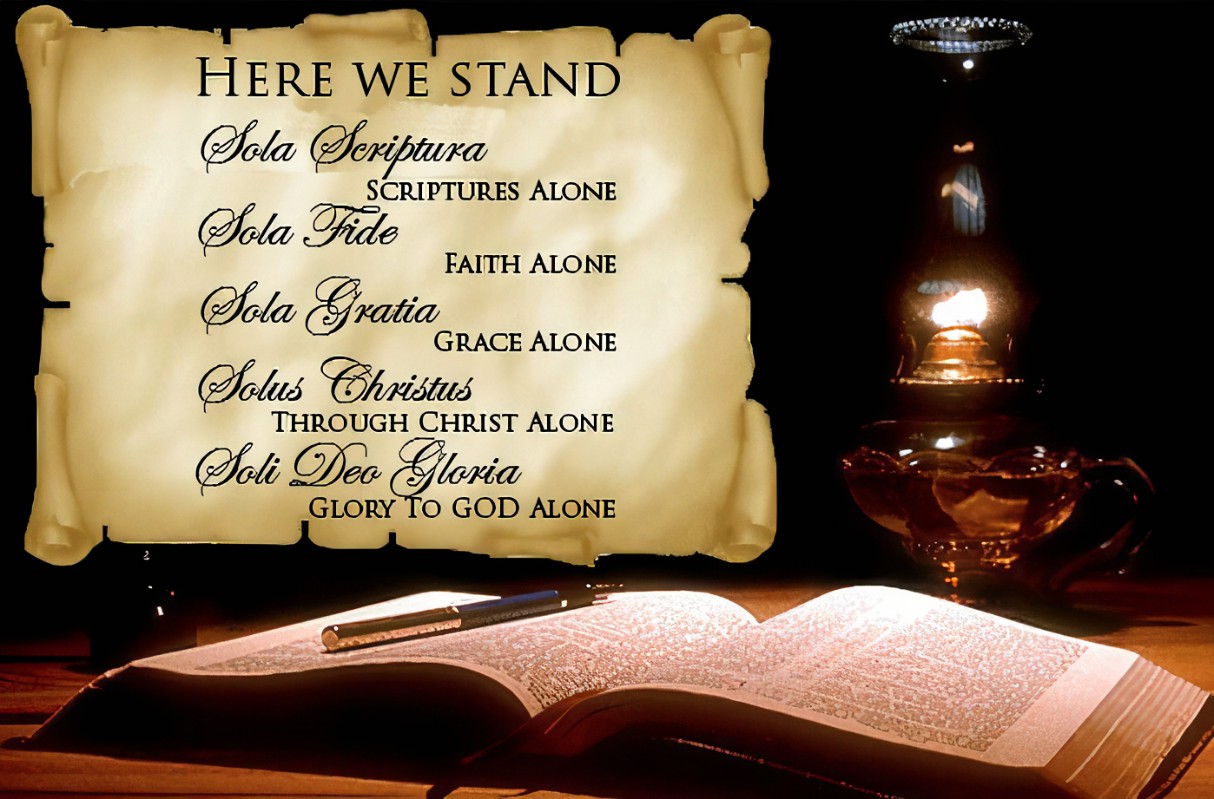
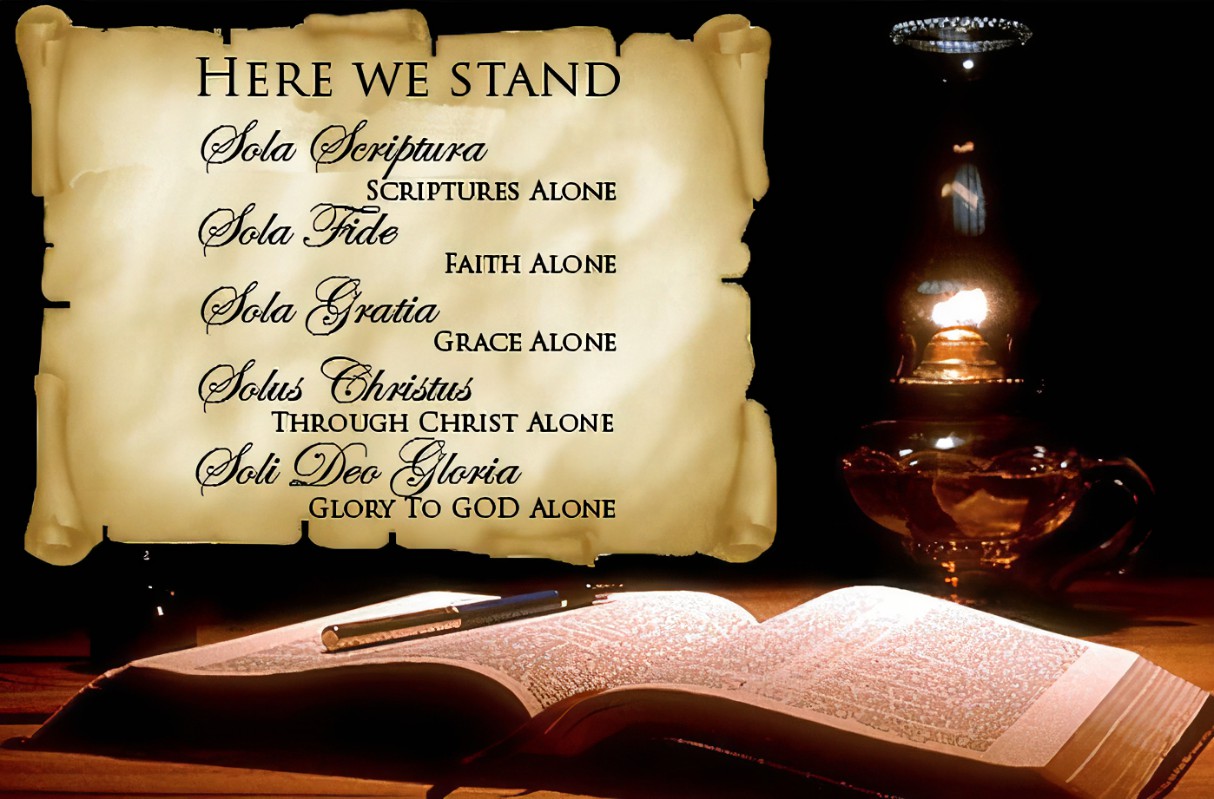
This historical event – this brief moment in time that literally turned the world, and more specifically, the church, on its head – should be remembered and commemorated by all who embrace reformation theology. But that is not the intent of this post. Rather, I would like for each of us to think about our own watershed moment in life. I would like for us to review, at least in our minds, that moment that we embraced the five “sola’s” that came about as a result of the reformation.

Take a moment to revisit that moment in your life when these five slogans that came about as a result of the reformation became personal for you. Think about that moment when you placed your eternal state on these five statements. You embraced the teachings of Scripture alone, which led you to accept Christ alone, through His grace alone, as a result of your faith alone, which culminated in your desire to live to the glory of God alone.

That moment for me took place on September 13, 1977. I will share more of my personal story in the next few posts. However, as I do so, I would love to hear from you. I would love to hear your story, and, with your permission, I would like to share your story so that other readers might be encouraged by your personal confession.

I am excited about these next few posts! I am really excited about the possibility of hearing your story – and the opportunity to share your story with others. Let’s be encouragers for one another. As the writer of Proverbs says:

As Iron sharpens iron, so a man sharpens the countenance of his friend.

Proverbs 27:17, NKJV

So, let’s sharpen one another with the story of our own personal watershed moment when we committed our lives to Jesus Christ. I can’t wait to hear from you.

Until next time:

Blessings!

Live Like a Citizen of Heaven

If you are a Christian, you are not a citizen of this world trying to get to heaven; you are a citizen of heaven making your way through this world.

Vance Havner

The apostle Paul states in his letter to the Philippians that our citizenship is in heaven. We are not home here. We are passing through. We are making our way through foreign territory. This is not our home. How, then, are we to live as we pass through?

I have been privileged to go on several mission trips outside the United States. In preparing for each one, we were given materials containing information about common customs in the countries we would be visiting. We were told that some things that are common practices in the US were thought to be offensive in the country we were visiting, and that we should refrain from engaging in those activities. We also were encouraged to learn some basic sentences so that we might be able to communicate in the most elementary of ways. We were going there as visitors – just passing through.

One extremely important point was drilled into us as we prepared for our trips: The citizens of the country we were going to would, for the most part, develop their ideas about citizens of the US based on our conduct and behavior. They would stereotype all Americans by what they saw in us. We were to strive to be the best representatives of the US as possible.

But, more importantly, we were to be the best representatives of Jesus Christ as possible. After all, we were not going as emissaries of the US, but as ambassadors of Christ.

What I would like to suggest in this blog is that this should be true of us while are here, in the US, as citizens of this country. Even though we are American citizens, we are first and foremost citizens of heaven. Our lives should bear testimony to that reality and that relationship more than the fact that we are citizens of an earthly nation. I am a citizen of heaven. I am a child of the King. I am an ambassador for Christ. What people see in me will play a role in their understanding of who Jesus Christ is, and what it means to be His child, and a citizen of His kingdom.

The Bible is replete with invaluable information and instruction on how citizens of heaven should live as they pass through this life on their way to heaven. We should strive to never engage in any activity, behavior, or lifestyle that would bring reproach to Jesus Christ. We are to be diligent students of His teachings, avid followers of His example, and dedicated, consecrated representatives of His kingdom. The citizens of this world are in desperate need of seeing genuine, sincere, born-again, Bible-believing Christians who are serious about being the best representatives of Jesus Christ possible.

We are sojourners, passing through. Don’t settle down. Don’t fit in. Don’t drive the stakes down too deeply. Don’t get comfortable. Don’t compromise with the cultural, societal, and traditional practices of a fallen world. Live like a citizen of your heavenly home. Live like a child of the King.

Until next time;

Blessings!

How Do We Handle the Big Surprises of Life?

Life is filled with surprises. We can plan for the future, and indeed we should, but we must do so with the understanding that the future we have planned may or may not come about as planned. Life happens, and plans have to be amended, revised, and adapted, or even discarded altogether. Yes, indeed, life is filled with surprises.

As we look around the world through the lens of media, we see things happening that can catch us off guard, taking us totally by surprise. I feel quite certain that the people of Israel were not expecting missiles to rain down on them two weeks ago, but they did. I feel sure that they were caught completely off guard and unprepared for that terrorist attack at the hands of Hamas. And not only were the people of Israel shocked, the world at large was also, as the events unfolded before us through the lenses of media.

When we witness things such as this, we need to remind ourselves of a few things that are essential for our mental and emotional wellness. First, let’s remember that the event itself happened at a specific moment in time. If we are not careful, we allow that moment in time, that minuscule, microscopic, fleeting split second of time, to define what we might refer to as the big picture – the entire scope of reality. That is an extremely dangerous thing to do, as it could cause all sorts of mental and emotional anguish. It’s like the feeling that we sometimes experience when we have come down with the flu, or pneumonia, or some other ailment. While we are in the throes of the ailment, we feel that it will never end. We can’t see beyond the present crisis. But the big picture is that it will end, and things will get back to normal. What happens in the moment does not necessarily result in affecting the big scope of things.

Second, we must refrain from allowing any event in the scope of human affairs to cause us to take our eyes off the One who is in control of all things. The present-day crisis in Israel is a great case in point. Those in the midst of the crisis are probably wondering if, or when, this crisis will end. Some may have resigned themselves to the idea that it will never end – that this is the beginning of what will prove to be the beginning of an accelerating string of events that will get worse and worse until the end of this present age. And, in reality, that could happen, but it is not necessarily going to happen. There is a sovereign God sitting on His throne, overseeing the affairs of man and of nations. We can rest with assurance in His ongoing care for His creation, and of the fact that the end was preordained from the very beginning. History has always been moving toward a climactic end, and God will bring that end about according to His timetable.

Third, it is imperative that believers should remember that we are not promised a life of ease, without any type of suffering, difficulty, and trouble. As a matter of fact, Jesus promised that in this world we would have difficulties and troubles. But He also promised that He would be with us in the midst of all that we face. He does not promise to remove us from every difficulty, but that He will be with us through the difficulty. Suffering is a result of the fall of man into sin. Every form of suffering is a direct result of sin, but not necessarily the direct result of personal sin. This means that we are all prone to suffer, regardless of our spiritual state.

The Old Testament teaches clearly that when the nation of Israel suffered at the hands of other nations, the righteous remnant suffered right along with the unrighteous. If the United States of America should ever be attacked by another nation, the same will be true: the righteous and the unrighteous will suffer alongside one another. We are not going to be placed under some form of protective bubble that will give us safety while all around us are facing trauma and disaster. No, we will all suffer the same. And again, this should not cause us undue concern, because the Bible has given us ample testimony and teaching concerning this grave matter.

So, what is the point? Simply this: God is in control. The brutal attacks against Israel at the hands of the terrorist group, Hamas, are under His control. Does that mean God is the instigator of this horrific event? Certainly not. But He is going to use these events to move history closer to that appointed time at which He will intervene on behalf of His chosen people. As the apostle Paul stated, “All Israel will be saved.” We are not to understand this as a statement of affirmation that every individual Israelite will be saved in the spiritual sense, but that in that last day of cataclysmic attacks against Israel in that final great battle, God will intervene and save national Israel from destruction.

God is in absolute control. All things are moving along as He ordained from eternity past. We are seeing them unfold before us in powerful ways. And the word of admonition from the Bible is that we need to make sure we are prepared for that final day when the angel will shout, the trumpet will sound, the Lord shall descend, and believers will be taken home.

Are you ready? Make sure you are before it is eternally too late.

Until next time:

Blessings.

What on Earth Will Keep You Out of Heaven?

By faith Moses, when he became of age, refused to be called the son of Pharaoh’s daughter, choosing rather to suffer affliction with the people of God than to enjoy the passing pleasures of sin, esteeming the reproach of Christ greater riches than the treasures in Egypt; for he looked to the reward.

Hebrews 11:24-26, NKJV

Do you have the assurance of salvation through the substitutionary death of Jesus Christ? Have you placed yourself, by faith, into His saving hands, and received His saving grace? The only means of salvation is the completed work of Christ. It is through Him, and Him alone, that one can be saved. Jesus said it as plainly as He possibly could when He asserted:

I am the way, the truth, and the life. No one comes to the Father except through Me.

John 14:6, NKJV

There are not many roads to heaven: only one. Jesus is that road. And yet, there are those who claim to have a relationship with Him, while living in open rebellion to His Word. Think for a moment about the words of the writer to the Hebrews quoted above. He states pointedly that Moses chose to suffer affliction with the people of God rather than to enjoy the fleeting pleasures of sin.

Please note carefully that he uses the word ‘pleasures’. The pleasures of sin. Sin is pleasing, enjoyable, fulfilling, satisfying, alluring, engaging, appealing, delightful, gratifying. Until it isn’t! As someone has aptly said: Sin will take you farther than you want to go; keep you longer than you want to stay; cost you more than you want to pay.

But, it is so pleasurable, so desirable, so alluring. And the Bible readily admits that it certainly is – all that and more. But in the end it is so deadly – not just physically deadly, but spiritually, and eternally deadly.

So to my question posed in the title of this post: What on earth will keep you out of heaven? Will you choose an earthly pleasure over an eternal home in heaven? Will you choose a behavior, a lifestyle, a worldly-minded attitude toward life, while rejecting the Bible’s teachings on righteous living. Will you choose the world’s pleasures over the kingdom of heaven? Are the momentary, fleeting, passing, temporary pleasures of this life worth spending eternity in hell, separated from God?

Jesus paid the ultimate price so that we might be saved from eternal torture. And yet there are multitudes who purposely, volitionally, knowingly, reject His offer of eternal pleasure for the passing pleasures of a sinful lifestyle.

God, in His amazing grace, has provided the means and method by which and through which we might be saved. But we must, by faith, turn in repentance from our sin, commit our lives to Jesus as our Savior, turn away from the passing pleasures of this world, and be made new. As the Apostle says, we are to put off the old and replace it with the new. The new is based on the teachings of Scripture. By the grace of God, and through the process of ongoing sanctification, we then become more and more conformed to the image of Christ, and less and less to the mold of the world.

So, what on earth are you allowing to keep you out of heaven? Whatever it is, turn to Jesus Christ by faith, confess your sin, accept His forgiveness, and begin an exciting new life with Him – giving up the passing pleasures of the earth for His eternal blessings of eternity with Him.

Until next time:

Blessings!

The Current Middle East Crisis

The events of recent days in the Middle East should not take anyone by surprise – at least anyone who reads the Bible. Just a cursory reading of the Old Testament provides ample evidence that there will always be antagonism and dissension between the descendants of Ishmael and those of Isaac. Isaac is the son of promise: the son God promised to Abraham and Sarah. The son through whom the nation of Israel would ultimately come. Ishmael, on the other hand, was the son of Abraham and Sarah’s handmaid, Hagar. It was through the descendants of Isaac that the nation of Israel came into existence, and through the descendants of Ishmael that the Arab nations arose. History proves again and again how antagonistic the Arab nations have been toward the nation of Israel, and, truth be known, how Israel has been just as antagonistic toward them.

The current war being waged between Israel and Hamas is another graphic example of this ongoing strife between the descendants of Isaac and Ishmael. It has been prophesied in the Old Testament and is coming to pass before our very eyes. But the question I would pose as we look at the horrific news reports coming out of this war is this: is this war justified? Was the attack by Hamas based on the principles of just war theory? Or would it be better described as holy war? To answer that question, let’s review briefly the definitions of those two terms.

First of all, let’s review just war theory. This theory is used to determine when it is ethically permissible to go to war. The determining factors are:

  • Is it for a just cause?
  • Is it based on a right intention?
  • Is it by a legitimate authority?
  • Does it have due proportionality?
  • Does it have a high probability of success?
  • It is a last resort?

I will quickly admit that I am not knowledgeable enough of Hamas belief and practice to give a definitive response to their understanding of, or concern for, going to war based on the just war theory. But from what I have seen, and what I have read, concerning this war, at least four of the seven questions listed above would have to be answered negatively. And it is very possible that all seven would have to be answered with a negative response.

So, let’s move to the second possibility: holy war. If Hamas has not followed the rules of just war, then perhaps this present conflict would have to be described as something different. So, what exactly is a holy war? Holy war is war based on religious belief, and motivated by one religion’s desire to destroy those of another religious affiliation.

An absolutely crucial matter to be considered is the fact that holy war is never commanded, nor condoned, in the Bible. Some reason that God’s command to Joshua to invade and take possession of what would become the geographical boundaries of Israel was a command to engage in holy war. However, this invasion and eventual possession of the land was not warfare based on religious belief, but rather it was based upon the wickedness of the inhabitants of the land. As a matter of fact, it is reiterated time and again that it was not because of the goodness of the people of Israel, but rather because of the wickedness of the people of the land that God gave the command to completely drive out the inhabitants.

Another major factor is that God never commanded the people of Israel to completely destroy all people, but just the people in the land of promise. So, it was not a holy war in the sense of being based on religion, but it was a just war based on the wickedness of the people of the land.

In conclusion, let’s go back to our topic under discussion. Was Hamas justified in their surprise attack on Israel? Was this attack in alignment with the principles of the just war theory? In my estimation, the answer is a resounding ‘No’. Was Israel just in their response to this attack? Again, in my estimation, the answer is a resounding, ‘Yes’. Why? Because all seven of the questions listed above could be answered in the affirmative to Israel’s response.

I do not claim to be an expert on this subject. I can only offer my personal opinion. But I do feel that my opinion is correct based on my knowledge of the current state of affairs. Also, based on my understanding of Old Testament prophesy, these events should not catch any Christian by surprise, but should rather serve as a wake-up call – the sound of the trumpet is drawing near! Be ready!

Until next time:

Blessings.

All In

In my last post, I wrote about the importance of words. Oftentimes there are words or phrases that sort of catch on and are used to convey a certain idea or truth. One such phrase that is seen with increasing regularity, especially in social media, is the phrase, “All In”.

This little two-word phrase simply means that the one who says it is totally committed to something. For example, after a favorite football team loses a game, many of the fans of that team will state that they are still “all in”, totally committed to that team, regardless of whether they win or lose.

Those of us who profess faith in the Lord Jesus Christ could apply this phrase to our commitment to the Lord. Are we all in? Are we totally committed to Him, regardless of what that commitment might cost? What would that kind of commitment look like? How would our lives look if we were all in for Jesus?

From the teachings of the Lord, we can glean some interesting characteristics of being all in. First, let’s consider that being all in would mean that we live visible lives for the Lord.

Being all in would mean that we live visible lives for the Lord.

Jesus said that our lives should be shining lights so that people could see our works. This, in turn, would bring glory to the Lord. The fact that we are all in for Jesus should be visible for all to see. This is done by the obvious things we do in service to the Lord. It is visible in our conduct, our behavior, our habits, our attitudes – in essence, every aspect of our public and private lives should be a visible display of being all in for Jesus.

Second, being all in would mean that we live vocal lives for the Lord. This, in part, goes back to my previous post on “words”. What we say, the words we choose, and even how we say those words, should be a clear reflection of being all in.

Being all in would mean that we live vocal lives for the Lord.

If you are like me, you enjoy talking about things that are important to you. I talk about the North Carolina Tarheels and the Dallas Cowboys, especially during football season, because I consider myself an “all in” fan of those two teams. I enjoy talking about them, and oftentimes catch a lot of flack because of my commitment to these two particular teams. But, being a vocal “witness” to my being all in is something I do with consistency and regularity.

Should I not be a vocal witness for the Lord? Should I not be quick to tell people about Him? He loved us enough to give His life for us – does that not warrant us being vocal witnesses for Him? Indeed, it does!

Third, being all in would mean that we live viable lives for the Lord. Viability means that something is capable of working successfully. You may be wondering why I would use this word to describe being all in.

Being all in would mean that we live viable lives for the Lord.

Jesus taught many things that would lead us to understand why our lives should work successfully for Him. He said if anyone puts his hand to the plow, and then looks back, he is not fit for the kingdom of God. He also said that if He is not first priority in our lives – even over our parents, brothers and sisters – then we cannot be His disciples. He further stated that we cannot serve God and mammon. Our lives should work successfully in the sense that we are all in for Him, living lives of consistency in our commitment.

I am all in and excited about what has happened thus far this season with the Tarheels and the Cowboys. I am thrilled that both teams are off to a great start. I am quick to engage in conversation about my excitement for their potential as the season progresses.

But my being all in for two football teams should be nothing compared to being all in for Jesus. I should be always ready to give an answer for the hope that is within me because of my relationship with Him. And I should share that hope with anyone and everyone who would take time to listen.

Are you all in?

Until next time:

Blessings.

Words

Sticks and stones may break my bones, but words will never hurt me.

Cute little saying, isn’t it? We’ve all heard it, maybe even said it. Perhaps in childhood, in a moment of childish confrontation and conflict with a friend, something was said, some hurtful words were spoken. They were aimed directly at you. You caught the weight of those cutting remarks, and your spirit was momentarily crushed. Even now, as you read these words, some incident from childhood is spinning around in your mind, reliving that moment in time long ago when you suffered from the cutting remarks of a friend.

So what did you do? Maybe, just maybe, you bent forward at the waist, glared at the friend who spoke the hurtful words, stuck out your tongue, and then shouted, “Sticks and stones may break my bones, but words will never hurt me.” But they did hurt. Tears began to flow down your cheeks. Your face was flushed. And yes, you were hurt by the words. They still haunt you, even all these years later.

Words are powerful. With words we can communicate love, or hate; encouragement, or discouragement; joy, or sadness. Parents, to a large extent, mold their children by speaking certain words to them with consistency. “You’re just stupid!” “You’ll never amount to anything!” “You’re ugly!” “You’re fat!” “You sure know how to pick them, don’t you?” “Let me do that – you never do anything right.” And on and on and on.

Even as adults, if we are told consistently that we are stupid, or incapable, or that we’ll never amount to anything, then chances are we will eventually believe it. We will then begin living out the reality of those hurtful words.

We need desperately to learn how to guard our words. We need to speak with love, and encouragement, instilling in others a sense of confidence. Please note that I am not saying that we candy-coat the truth. Sometimes we have to use words that do not seem to be uplifting and encouraging, but they need to be spoken. Children sometimes need to hear the word, “No”, teaching them that certain behaviors or actions are not permissible. But even those words need to be spoken with love and encouragement.

Husbands and wives need to speak to one another with love, respect, and the desire to build each other up. In my years as pastor, I have counseled with many couples, and listened to them bash each other verbally in my presence. I sat and wondered, “If they speak to one another like this in my presence, it must really be a war zone in their home,”

Words. Powerful tools that can be used for good, or for bad. They can build up, or tear down. They can help a child, or adult, develop confidence in themselves, or destroy any sense of self-worth. They can help a person believe in themselves or buy into the idea that they really are worthless, incapable of accomplishing anything in life.

Let’s make a concerted effort to use our words wisely. To use words to build up, to encourage, to instruct, to counsel, to advise, to guide, to correct, to help in any way possible, so that the person receiving our words may be uplifted and encouraged. And, even when we must speak words of admonition, do it with love.

Parents, grandparents, let’s speak uplifting, encouraging words to our children and grandchildren. Husbands, wives, let’s do the same with our spouses. Employers, employees, speak kindly to one another, building each other up. Let’s commit to use our words are tools of good, for the good of others.

Until next time:

Blessings!

The Saddest Words

What are the saddest words you could ever hear? Would it be hearing your doctor inform you that you have an incurable disease, with only weeks to live? Would it be hearing your spouse tell you that they no longer love you, and want out of the relationship? Would it be a phone call informing you of an accident that took the life of your child? Would it be your banker calling to tell you that your account has been hacked, and your life savings have been stolen? Or one of a million other possibilities?

Words can be devastating. In a single moment, our lives can be irrevocably altered by hearing words that destroy us, leaving us in the wake of a verbal Sunami. Our lives can be shattered, changed forever, by simply hearing certain words.

But, as sad as the words stated above would be to hear, there are some other words that I feel are far sadder, far more devastating, far more destructive than any of them, or even of all of them combined. The saddest words in all of human language were spoken by the Lord Jesus Christ, and are haunting, even terrifying, to hear.

I never knew you; depart from Me, you who practice lawlessness!

Matthew 7:23, NKJV

What unbelievably horrific words! These are words of eternal significance. Those to whom the Lord speaks these words will then be cast into the abyss of hell, to be forever separated from God. There are several matters of grave importance we need to make note of.

First of all, consider the people who hear these words: ‘you who practice lawlessness.’ We might read those words and think that Jesus is referring to wicked, evil, people who have lived their lives in unabated sin. The Apostle Paul gives a list of sinful lifestyles and behaviors that give an idea as to the kind of individuals we might think Jesus is referring to in His statement.

Now the works of the flesh are evident, which are: adultery, fornication, uncleanness, lewdness, idolatry, sorcery, hatred, contentions, jealousies, outbursts of wrath, selfish ambitions, dissentions, heresies, envy, murders, drunkenness, revelries, and the like; of which I tell you beforehand, just as I told you in time past, that those who practice such things will not inherit the kingdom of God.

Galatians 5:19-21, NKJV

That list certainly contains lawless behaviors. The Word of God clearly forbids each of these as rebellion against God’s prescribed law. However, a little closer look at the words of Jesus quoted above reveal that the individuals who practice such things as those listed by Paul are not the people to whom He refers. Let’s look at the context of Jesus’ statement.

Many will say to Me in that day, ‘Lord, Lord, have we not prophesied in Your name, cast out demons in Your name, and done may wonders in Your name?’ And then I will declare to them ‘I never knew you; depart from Me, you who practice lawlessness.’

Matthew 7:22-23, NKJV

It should be quite obvious that those in the list given by Paul will not inherit the kingdom of God, but Jesus is speaking here of good people, relatively speaking. He is talking about religious individuals – people who have been involved in religious activities, even claiming to have performed those religious activities in the name of the Lord. But Jesus says that even those good works are actually works of lawlessness.

It is not what we do for the Lord, or in the name of the Lord, it is what the Lord has done for us, and our humbling ourselves before Him to ask for and accept His gracious offer of salvation. Please don’t fool yourself into believing that your good works, even those you’ve done in the name of the Lord, will gain you entrance into heaven. Your good works should be done out of your relationship with Him and not to earn a relationship with Him.

Please make sure that you have a relationship with Jesus Christ on the basis of His redemptive work, and not on the basis of your religious works. One will get you into heaven; the other will send you straight to hell. Yes – even ‘good works’ will result in spending eternity separated from God in hell.

So, it all comes down to the choice between religion and relationship. Make sure yours is the right choice.

Until next time:

Blessings!

Spectator, or Participant?

At the base of a mountain that is popular for mountain climbing on its steep, jagged, face lived a woman whose house had a perfect view of any climbers who dared to attempt to master the mountain. One morning, as she sat outside sipping on her coffee while reading a few pages in her newest novel, she noticed a group of people setting up camp. She watched with keen interest as they unloaded all the gear they would need to climb the most dangerous slope.

She quickly went into her house to get her binoculars so she could see more clearly, and watched carefully as they checked, then double checked, all the equipment that would be needed to make a safe climb. As the sun began to set on the other side of the mountain, she watched as they all made their way into their tents to get a good night’s rest for their arduous first day of the climb.

Early the next morning she made her way out to the spot where she would have the most unobstructed view of the mountain. She eagerly waited to see how many of the group were actually going to make the climb. Some, of course, would remain at the base camp in case of any emergencies that might arise. Six of the eight in the group were going to attempt the climb. It would be a difficult task, climbing the most dangerous part of the mountain face.

The first day of the climb was the easiest, as the base of the mountain was not as steep, and not nearly as sheer as the upper portion of the climb. So, they made their way in good time to a pre-selected place where they would make camp for the night. The second day was a little more difficult, but the third day would be the most challenging of all.

The woman watched intently, only going into her house for brief periods, not wanting to miss any of the action. She sat comfortably in her expensive lounge chair, with everything she needed at her fingertips so that her time away from the action would be minimal.

As the third day’s climb began, it was obvious that much more caution would be necessary, as this part of the climb was by far the most treacherous. But the six men made their way without any difficulty at all. As they reached the summit, and as the last of the six men ascended the top, the woman became ecstatic with excitement. She made her way into the nearby village, and began to exclaim, “We made it! We made it!” to all who would listen.

Some stopped to gaze at this half-crazed woman, while others tried to move away from her with haste. Some began to snicker and sneer, while others simply rolled their eyes and walked away.

One, however, walked over to her and asked, “Were you a participant, or merely a spectator?” The woman, after being asked this probing question, got quiet, and slowly walked away.

You see, she didn’t make it. As a matter of fact, she didn’t do anything – but watch. She sat in comfort while those six men put their lives in danger, and took great risks, to climb that dangerous mountain.

There are many in church who are like that woman. When the church does something, they are quick to identify with the church. “That’s my church.” Or, “Did you here what we did down at the church?” Or, “We have baptized 70 people this year!” Or, “We have so many special ministry events planned for this coming year.”

But in reality, the pronoun “we” should not be used by many. Rather, to be correct in our grammatical sentence-structuring, the pronoun “they” would be more appropriate. “We” are oftentimes bystanders, spectators, while we watch as “they” do the work.

Someone has said that in most churches, 10% of the members do 90% of the work. The 10% are like the pillars, shouldering most of the responsibilities and carrying most of the workload. The other 90% are like caterpillars: they just crawl in and out.

Are you a pillar, or a caterpillar.

Be a pillar!

Until next time:

Blessings.