Where would we be without Easter? Before I address that question, let me take a moment to address the issue of the word itself. Is Easter found in the Bible? Well, yes, and no. The word is found in the King James Version of the Bible. Found in Acts 12:4, the verse reads: “And when he had apprehended him, he put him in prison, and delivered him to four quaternions of soldiers to keep him; intending after Easter to bring him forth to the people.” This is in reference to Peter being arrested, and kept in his cell until after Pascha (Hebrew for Passover). Thus, it is a clear reference to the Jewish feast of Passover rather than to a day referred to as Easter.
Is this really important? I think that we will reach the solid conclusion that it is crucially important when we understand the significance of the word. Easter has no place in the original languages of the Bible. There are varying explanations as to how the word “Easter” came to be in English translations of the Bible, but the one that seems to have the most consensus is that when the King James Version (KJV) was translated in 1611, the word Easter was commonly used in reference to the Passover, and would have had that understanding to those in that era who read that particular translation. However, with the changing of the definition of words through the years, it is now a matter of confusion. Thus, it is far better to understand Acts 12:4 as Passover, not Easter.
Now let’s consider the ramifications of not using the word “Passover”. Passover is one of three Jewish feasts that take place within an eight-day period. It begins on Sunday, and concludes on Sunday. The first Sunday begins the Feast of Unleavened Bread, during which all leaven must be removed from Jewish homes for the duration of those eight days. It then concludes on the following Sunday, which is the Jewish Feast of Firstfruits. Between these two Feasts is the Feast of Passover, which is celebrated on Thursday.
The reason we should be careful to use the right terminology relative to each of these Feasts is because Jesus is the fulfillment of all three. Let’s consider carefully this extremely important part of those Feasts of Israel, and how each is related to Jesus.
To begin with, these are not to be thought of as being types of Christ found in the Old Testament. Think of a type of Christ as being a symbol, or picture, or foreshadowing, of the coming Christ. There are many of these types of Christ found throughout the Old Testament. However, we must be careful that we do not think of Firstfruits, Passover, and Unleavened Bread as being symbols, or types of Christ. Why? Because the New Testament makes it clear that Passover is not a type of Christ, but rather that Christ IS Passover. Firstfruits is not a type of Christ, but Christ IS Firstfruits. Unleavened Bread is not a type of Christ, but Christ is the Unleavened Bread.
Read the following verses carefully:
“And Jesus said to them, ‘I AM the bread of life. He who comes to Me shall never hunger, and he who believes in Me shall never thirst.'” John 6:35
“But now Christ is risen from the dead, and has become the firstfruits of those who have fallen asleep.” 1 Corinthians 15:20
“Therefore purge out the old leaven, that you may be a new lump, since you truly are unleavened. For indeed Christ, our Passover, was sacrificed for us.” 1 Corinthians 5:7
Jesus Christ IS the Bread of life, Firstfruits, and the Passover Lamb. This should make it abundantly clear that those Feasts of Israel are all fulfilled in our Lord, Jesus. We must not allow the world’s practice of changing the meaning of words to adversely affect these three terms that are so profound as we think about the season we refer to as Easter. We must maintain a commitment to the clear teachings of Scripture, especially those that teach us these phenomenal truths about Jesus.
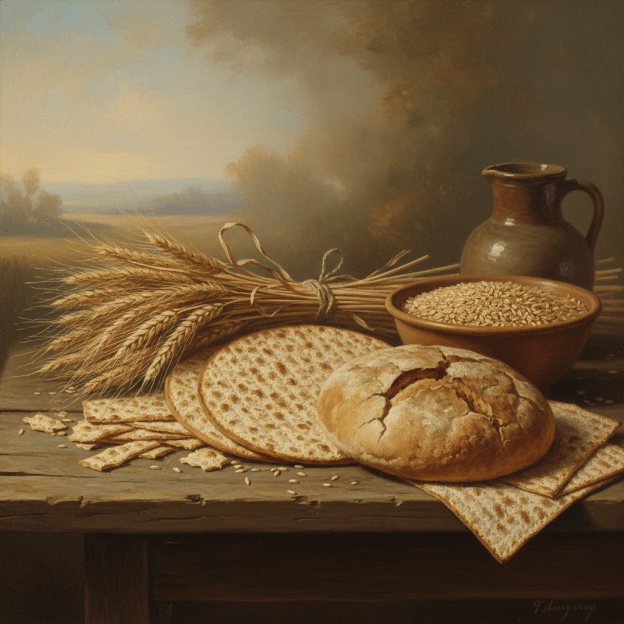
So, what exactly should we call the day we have come to know as Easter? Simple: according to God’s plan as laid out in the Old Testament, we celebrate Unleavened Bread (we normally refer to it as Palm Sunday), Passover (Thursday after Unleavened Bread), and Firstfruits (we call it Easter). To understand the meaning of these terms, and the significance of the Old Testament feasts that were all fulfilled in, by, and through Jesus Christ, will shed so much light and provide so much clarity in why these Christian celebrations are rooted in Old Testament worship.
For over 3500 years orthodox Jews have participated in Communion every time they celebrate Passover
And now for the reason for this blog. Did you realize that for over 3500 years orthodox Jews have participated in Communion every time they celebrate Passover? And secondly, did you also realize that for over 2000 years the church has celebrated a part of Passover every time they have observed the Lord’s Supper?
For over 2000 years the church has celebrated a part of Passover every time they have observed the Lord’s Supper
It was during the observance of Passover that Jesus took a specific piece of unleavened bread, broke it, and said, “This is my body given for you.” Then, He took the third cup of wine served during the meal, and said, “This is my blood, shed for you.” That is astounding! Jesus IS the Passover. He is the ultimate Passover lamb whose life was given for others.
It is remarkable how God actually provided these graphic portraits of His Son approximately 1500 years before His birth. What a mighty God we serve – Amen!
Blessings!
 Steve Stewart, Th.D.